This article may contain affiliate links. If you book through them, we may earn a small commission at no extra cost to you.
On this page
Introduction: The Castle Town That Escaped the Bombs
Kanazawa (金沢) owes much of its current reputation to a historical accident: the city was never significantly bombed during World War II. While Tokyo, Osaka, Nagoya, and most of Japan's major cities were systematically destroyed by incendiary raids, Kanazawa's relative military insignificance left its Edo-period urban fabric largely intact. The consequence — an accident of geography and strategic irrelevance — is that Kanazawa today contains the most complete surviving ensemble of historical districts outside Kyoto: a geisha quarter, a samurai district, a Buddhist temple district, a preserved merchant town, and a garden considered one of Japan's three greatest.
The nickname "Little Kyoto" (小京都 / ko-Kyoto) is applied to several Japanese cities that preserved historical character, but Kanazawa's claim is the strongest. The city was not merely preserved — it was actively cultivated as a center of art, craft, and culture throughout the Edo period under the powerful Maeda clan (前田氏), the wealthiest feudal domain in Japan outside the Tokugawa shogunate itself. The Maeda investment in the arts — Noh theater, lacquerwork, Kutani ceramics, Kaga Yuzen silk dyeing, Ohi pottery — created a cultural depth that Kanazawa maintains today through living craft traditions of exceptional quality.
Kenroku-en (兼六園): The Garden of Six Attributes
Kenroku-en is universally listed among Japan's Three Great Gardens (日本三名園) — alongside Kōrakuen in Okayama and Kairakuen in Mito. The name means "Garden of Six Combinations" — the six attributes of an ideal garden identified in Chinese landscape theory: spaciousness, seclusion, artifice, antiquity, water features, and panoramic views. Most gardens can achieve two or three of these simultaneously; Kenroku-en achieves all six.
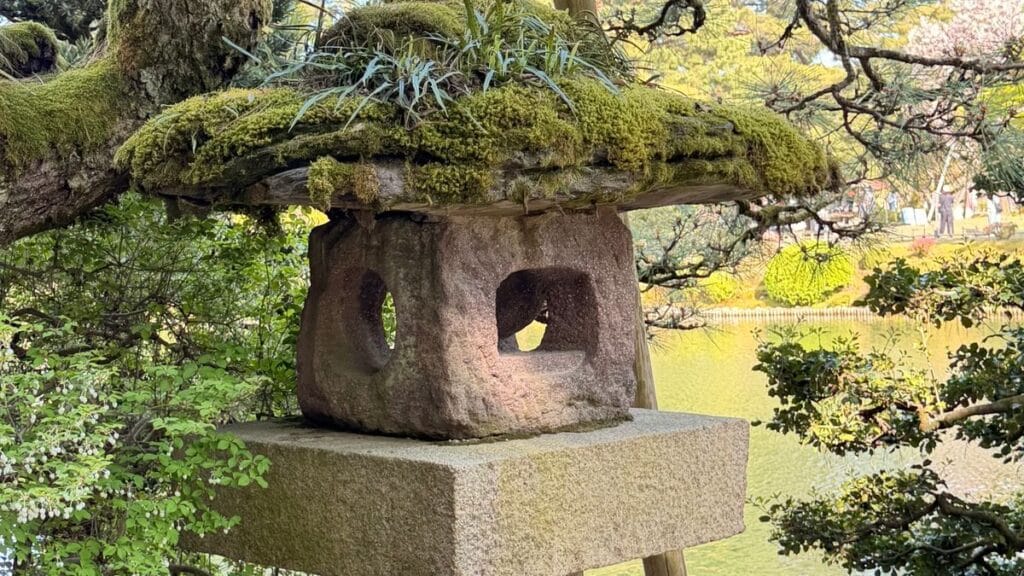
The garden was developed over two centuries by successive generations of the Maeda clan — beginning in the early 17th century and reaching its current form in the early 19th century. The result is a 11.4-hectare stroll garden of extraordinary compositional depth: the Kasumiga-ike pond (霞ヶ池) at the center, the Kotoji-toro lantern (琴柱灯籠) standing in the water on its distinctive two-legged base (one of Japan's most photographed single garden objects), the ancient trees maintained by specialist pruning, and the Midori-taki waterfall fed by an aqueduct completed in 1822.
Seasonal Character
Winter Snow Yukitsuri (雪吊り): From November through March, the garden's trees are protected from heavy snowfall by an elaborate system of yukitsuri (雪吊り) — rope cones extending from central poles to the branches, distributing the weight of accumulated snow to prevent branch damage. The process of installing the yukitsuri (completed annually in November) is one of Kanazawa's most distinctive seasonal rituals, and the completed garden in winter snowfall — the rope cones creating geometric patterns above the snow-covered ground — is one of Japan's most celebrated winter landscapes.
Spring: Approximately 200 cherry trees bloom in early April, and the combination of blossom over the ponds and stone lanterns creates compositions of exceptional delicacy.
Autumn: The maples and other deciduous trees turn in late October and early November, and the red foliage reflected in the Kasumiga-ike pond produces the garden's finest photographs of the autumn season.
Access: Kenroku-en is open daily from 7:00 AM (March–October) and 8:00 AM (November–February). Entry: ¥320. Arrive at opening for the best experience before tour groups arrive.
Higashi Chaya (東茶屋街): The Geisha District
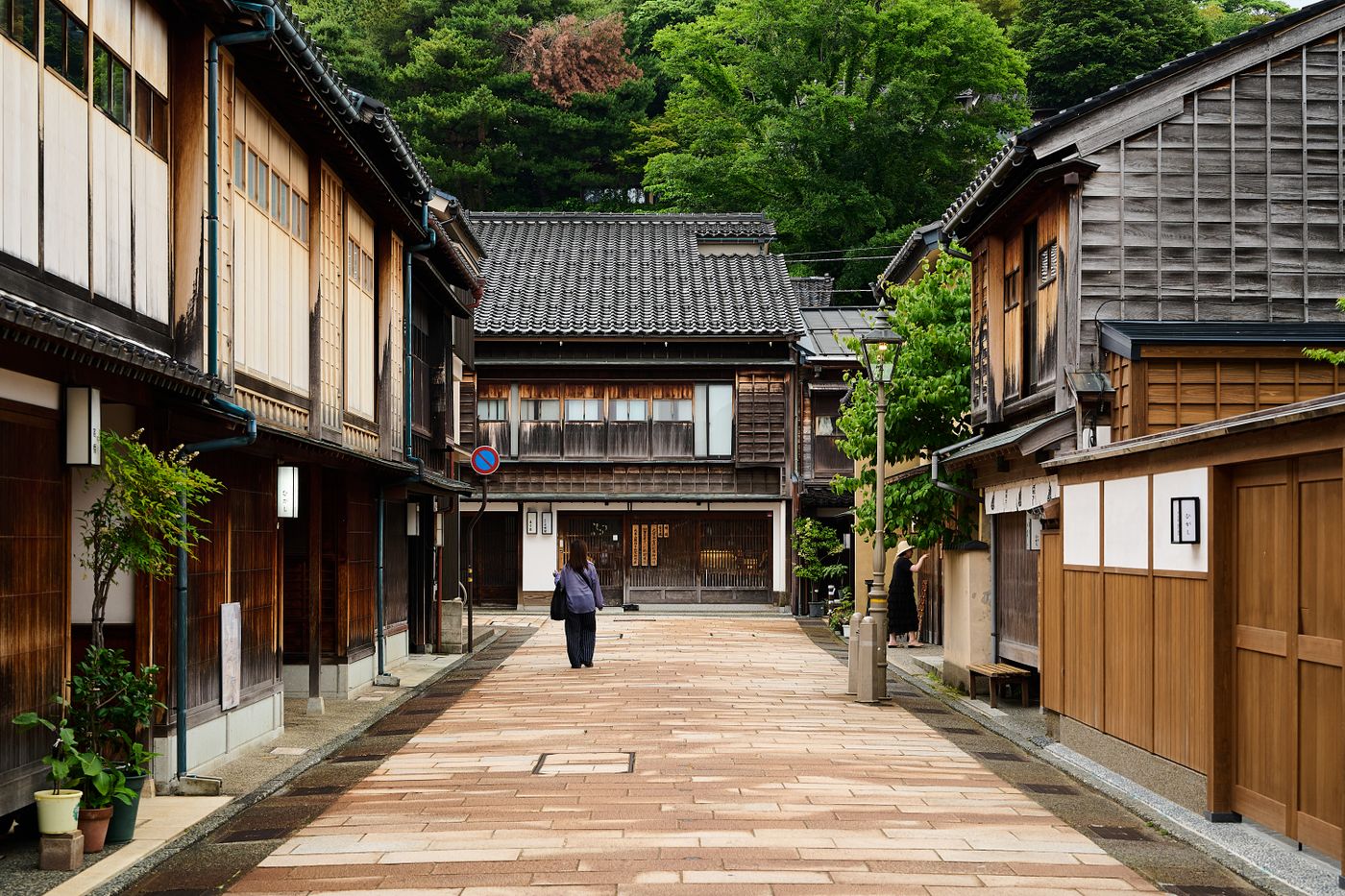
Higashi Chaya-gai (東茶屋街) — "Eastern Tea House District" — is the largest and best-preserved of Kanazawa's three geisha districts, established in 1820 when the Maeda clan formally organized the city's geisha culture into designated entertainment areas.
The district's main street is approximately 180 meters of latticed wooden facades (格子戸 / kōshi-do) — the characteristic architecture of the chaya (tea house) where geisha entertainment took place. The horizontal wooden lattices, the dark wood exterior, and the occasional sound of shamisen practice from within give the street an atmosphere that, particularly in the evening, comes closer to the world depicted in Edo-period woodblock prints than almost anywhere else in Japan.
Unlike Kyoto's Gion district (where the tea house culture is almost entirely private and visitor-facing activity is limited), Higashi Chaya has adapted to welcome visitors through several mechanisms:
Shima (志摩): A well-preserved tea house open as a museum, allowing visitors to see the interior layout of a functioning chaya — the reception rooms, the performance space, the staircase to upper private rooms, and the garden. The interior reveals how the geisha entertainment world actually functioned spatially.
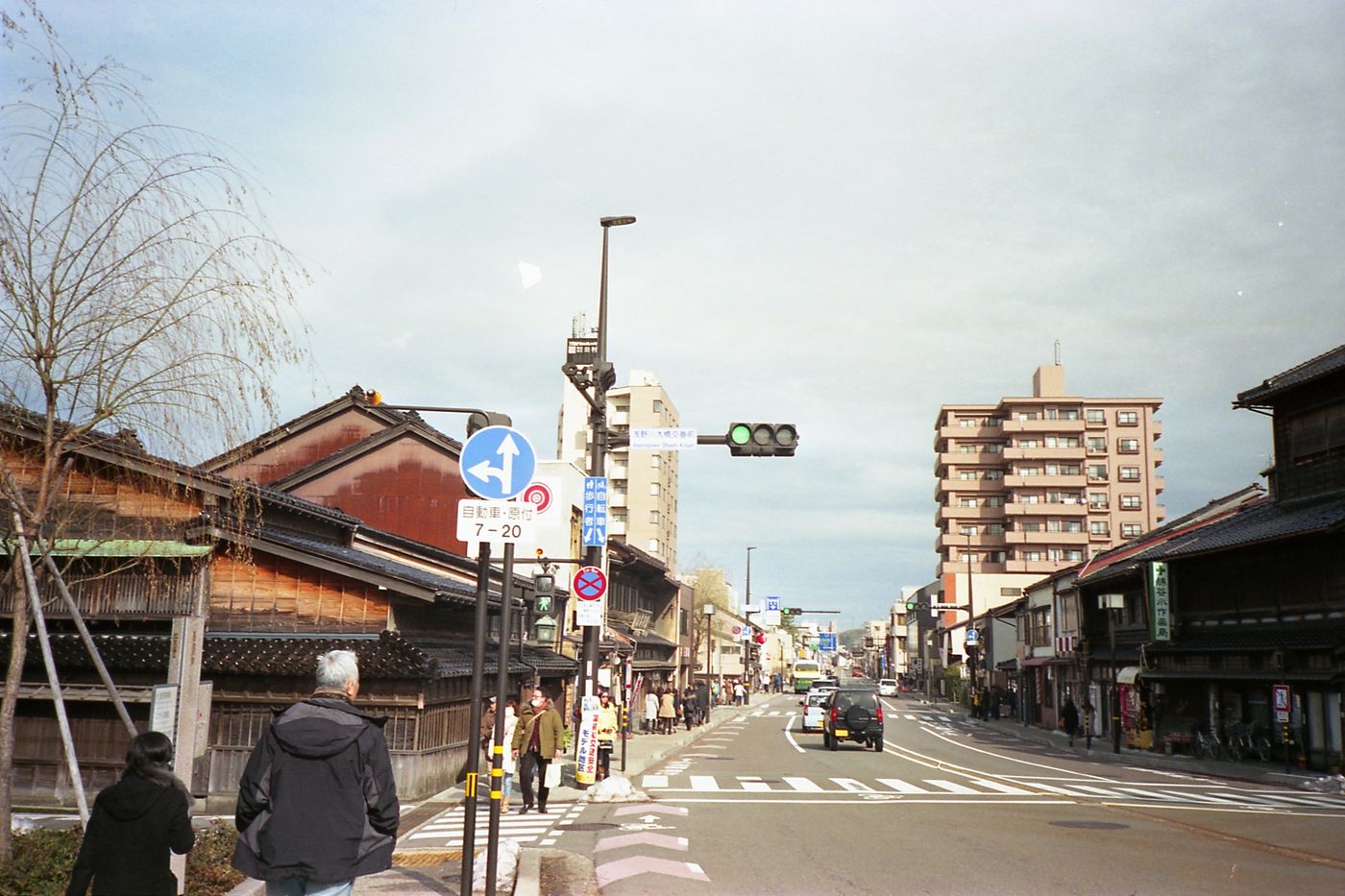
Kaikaro (懐華楼): The most prestigious chaya in Higashi Chaya, offering experiences that include matcha in the traditional performance room (¥1,000–¥2,000 per person, reservation required during busy periods). The building's interior — red-lacquered staircase, gold-leaf decorated walls — represents the most elaborate surviving tea house interior in Kanazawa.
Gold leaf (金箔) products: Kanazawa produces over 99% of Japan's gold leaf, and the Higashi Chaya district is the best place to encounter this craft in commercial form: gold-leaf-covered soft serve ice cream (the most photographed food in Kanazawa), gold-leaf cosmetics, lacquerware, and craft objects incorporating the material that defined Kanazawa's luxury aesthetic.
Omicho Market (近江町市場): The City's Kitchen
Omicho Market (近江町市場) — operating for approximately 300 years, occupying a covered market hall near the city center — is Kanazawa's most direct encounter with the extraordinary seafood available from the Sea of Japan (日本海). The market's approximately 170 stalls cover fresh fish, shellfish, vegetables, prepared foods, and restaurant stalls in a configuration that reflects centuries of commercial evolution.
Why Kanazawa's seafood is exceptional: The Sea of Japan's cold, relatively unpolluted waters produce fish and shellfish of outstanding quality, and Kanazawa's position on the coast — with the fishing port of Kanaiwa (金石) providing direct access — means the market receives product within hours of landing.
What to eat at Omicho:
Kani (カニ / Snow Crab and King Crab): The winter crab season (November through March) is when Omicho is most spectacular. Whole crabs in tanks, crab claws on ice, and the distinctive red-labeled "Kanazawa Kani" certification indicating local sourcing — the market in crab season is one of Japan's great seafood market experiences.
- Noto Oysters (能登牡蠣): From the Noto Peninsula's clean waters — large, rich, available October through April.
Buri (ブリ / Amberjack): The winter amberjack from the Sea of Japan — called "Kanburi (寒鰤 / winter buri)" to distinguish the cold-season catch, which develops exceptional fat content.
Kaisen-don (海鮮丼): The market stalls serving seafood rice bowls — assembled from the surrounding vendors' products — at prices reflecting market proximity rather than restaurant markup.
Nagamachi Samurai District (長町武家屋敷跡)
Nagamachi — the preserved samurai residential district southwest of the castle — contains the black mud walls (土塀 / dobei) and narrow lanes that housed the middle-ranking samurai of the Maeda domain. Unlike Kakunodate (where individual residences are open as museums), Nagamachi's character is more purely spatial — the walls, the lane width, the scale of the gates suggesting the hierarchy of the original occupants without formal museum presentation.
Nomura Residence (野村家): The one fully open samurai residence in Nagamachi — a single family's home preserved and maintained with original furnishings, garden, and art objects. The garden is considered particularly fine — a compact but accomplished composition using the rock and water elements characteristic of Kanazawa's garden tradition.
Kanazawa's Craft Traditions
The Maeda clan's investment in craft during the Edo period established living traditions that continue today:
Kutani Yaki (九谷焼): Kutani porcelain — characterized by brilliant overglaze colors (red, green, yellow, purple, and dark blue applied in dense patterns) — is among the most visually distinctive of Japan's regional ceramic styles. The Kutani Kosen Kiln (九谷光仙窯) and several galleries in the city offer the opportunity to see the production process and purchase directly.
Kaga Yuzen (加賀友禅): The Kanazawa style of yuzen silk-dyeing — known for its realistic natural motifs (flowers, birds) in deep, rich colors — is considered alongside Kyoto Yuzen as Japan's premier silk dyeing tradition. The Kaga Yuzen Traditional Industries Hall offers demonstrations and the opportunity to try the dyeing process.
Recommended Base Hotels
The Square Hotel Kanazawa (Luxury / from ¥28,000): Contemporary luxury adjacent to the 21st Century Museum of Contemporary Art.
Hotel Nikko Kanazawa (Mid-range / from ¥16,000): Kanazawa Station area, convenient for day trips to all districts.
- Uan Kanazawa (雨庵 金沢) (Boutique / from ¥22,000): Design hotel a short walk from the Higashi Chaya district.
Planning where to stay in Chubu & Hokuriku? Browse our honest hotel picks and area guides.
🏨 Planning where to stay?
Every area guide on this site pairs with honest, station-by-station hotel picks. Start here: Kyoto Hotel Guides →