This article may contain affiliate links. If you book through them, we may earn a small commission at no extra cost to you.
On this page
- Introduction: The Question the Town Itself Asks
- The Yufuin no Mori (ゆふいんの森): The Train That Defines the Journey
- Mount Yufu (由布岳): The Town's Guardian
- Kinrin-ko Lake (金鱗湖): The Morning Mist Scene
- The Main Street (湯の坪街道): Beautiful Problem
- The Onsen: Yufuin's Core Offering
- Is Yufuin Worth the Hype? The Honest Verdict
- Recommended Base Hotels
Introduction: The Question the Town Itself Asks
Yufuin (由布院) has been one of Japan's most popular onsen destinations for decades — and this popularity has produced a complex of feelings among people who love it. Visitors arrive expecting a quiet mountain hot spring village and find, in the peak seasons, a tourist infrastructure of considerable density: souvenir shops, cafés, galleries, horse-drawn carriage rides, and crowds moving slowly along the main approach street from the station toward the lake.
Is Yufuin still worth visiting? The honest answer is: yes, with conditions. The conditions relate entirely to when you go and how you approach it. Yufuin at 7:00 AM on a weekday in October — mist rising from the paddy fields, the outline of Mount Yufu (由布岳) emerging from cloud behind the town, almost no one on the streets — is one of the most beautiful small towns in Japan. Yufuin on a Saturday afternoon in November is a very different experience.
This guide tells you how to access the first version.
The Yufuin no Mori (ゆふいんの森): The Train That Defines the Journey
The Yufuin no Mori — a beautifully designed limited express with dark green exterior, large windows, and a bistro car — is one of Japan's most celebrated scenic trains. The journey from Hakata through the Oita mountains involves tunnels, viaducts, and valley crossings, and the train's large windows are designed to maximize the visual experience of the mountain landscape.
The train itself (reservation required; roughly ¥5,000–¥5,200 from Hakata including the seat fee as of July 2026) sets the tone for Yufuin — it is not just transportation but the beginning of the aesthetic experience the town offers. The bistro car serves Oita specialty food and local sake, and the combination of the passing mountain scenery and the quality of the on-board experience makes the journey an integrated part of the destination.
Mount Yufu (由布岳): The Town's Guardian
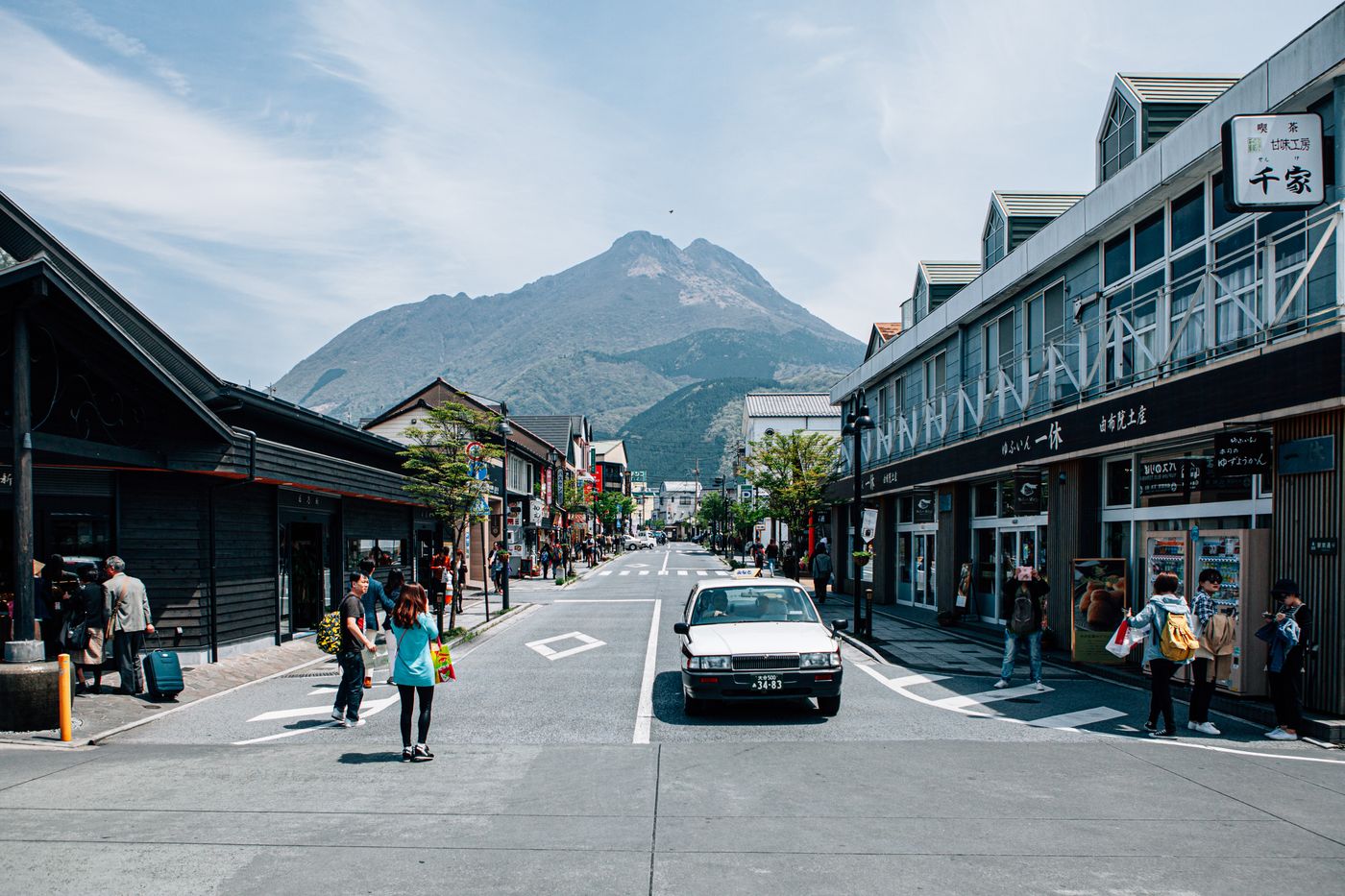
Mount Yufu (1,583 meters) — a double-peaked dormant volcano visible from virtually every point in the Yufuin basin — is the visual anchor of the town's identity. The relationship between the mountain and the town is unusually direct: the mountain is always present, framed by the streets, appearing at the end of lanes, reflected in the paddy water in spring and summer, half-concealed by cloud in autumn and winter.
Yufu-dake Hiking: The mountain is hikeable by reasonably fit visitors in approximately 4–5 hours round trip. The ascent begins from the Yufuin Yufu-dake Trail at the edge of town and climbs through meadow and forest to the summit, from which the Yufuin basin, Beppu Bay, and (on clear days) the island of Shikoku are visible.
The summit view looking back down at Yufuin — the small town, the lake, the paddy fields, the surrounding mountains — is the most complete view of the town's extraordinary geographic setting.
Kinrin-ko Lake (金鱗湖): The Morning Mist Scene
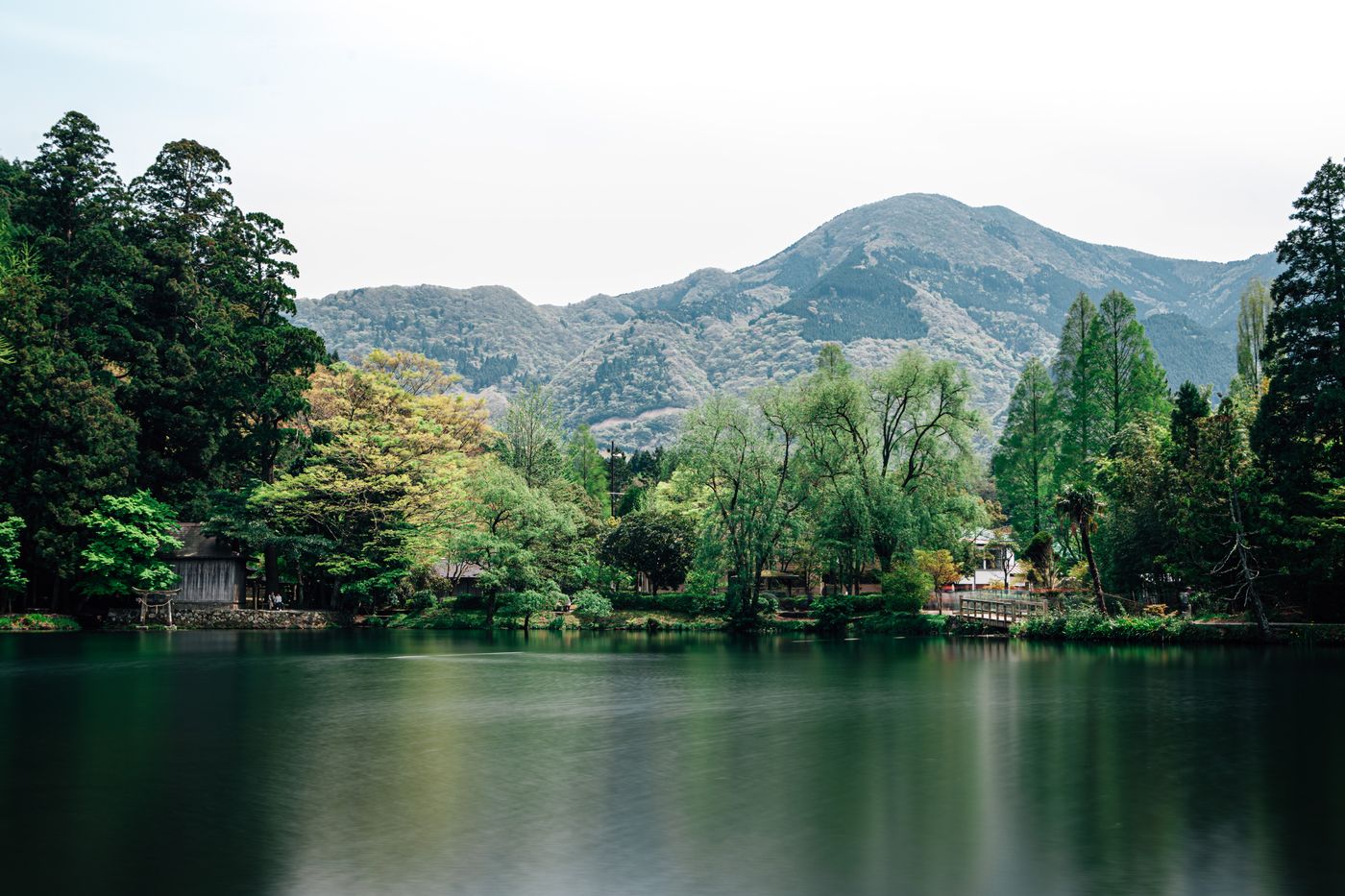
Kinrin-ko — "Golden Scale Lake," named for the gilded appearance of fish scales in the evening sunlight according to Meiji-era visitor accounts — is a small spring-fed lake at the far end of Yufuin's main approach. The lake is fed by both cold spring water and hot spring water, creating a temperature gradient that produces steam mist (朝霧 / asa-giri) on autumn and winter mornings when cold air meets the warm water surface.
The mist rising from Kinrin-ko on an October morning — with Mount Yufu behind, the surrounding willow trees in autumn color, and the lake's clear water visible beneath the mist — is the image that defines Yufuin in Japanese popular culture and explains why the town remains consistently beloved despite its crowds.
Timing: The morning mist is most pronounced from mid-October to December, between approximately 6:30 AM and 8:30 AM. Arriving at the lake before 7:00 AM in this period is the single most important timing decision in a Yufuin visit.
The Main Street (湯の坪街道): Beautiful Problem
Yufuin's main approach street (湯の坪街道) from the station to the lake is the source of the town's crowd problem and its commercial character: a 1.5-kilometer street lined with cafés, boutiques, galleries, art museums, and specialty food shops that has developed into one of the most densely commercialized rural main streets in Japan.
The quality of what is sold is genuinely high — Yufuin's commercial culture trends toward craft, local food products, and art rather than the standard souvenir fare. Several museums (the Yufuin Museum, the Yufuin Floral Village) and galleries are embedded in the street, giving it an arts-and-crafts character more sophisticated than most onsen town commercial strips.
The problem is simply the number of people during peak times. The solution is timing: the street before 9:00 AM and after 5:00 PM (when day trippers have mostly departed) has a completely different character.
The Onsen: Yufuin's Core Offering
Yufuin's springs — sodium bicarbonate and sodium chloride waters, slightly alkaline, known for leaving skin soft — are among the most enjoyable bathing waters in Kyushu. The springs here lack the dramatic chemical theatrics of Beppu's sulfuric varieties but provide a gentler, longer-lasting bathing experience appropriate to Yufuin's quieter character.
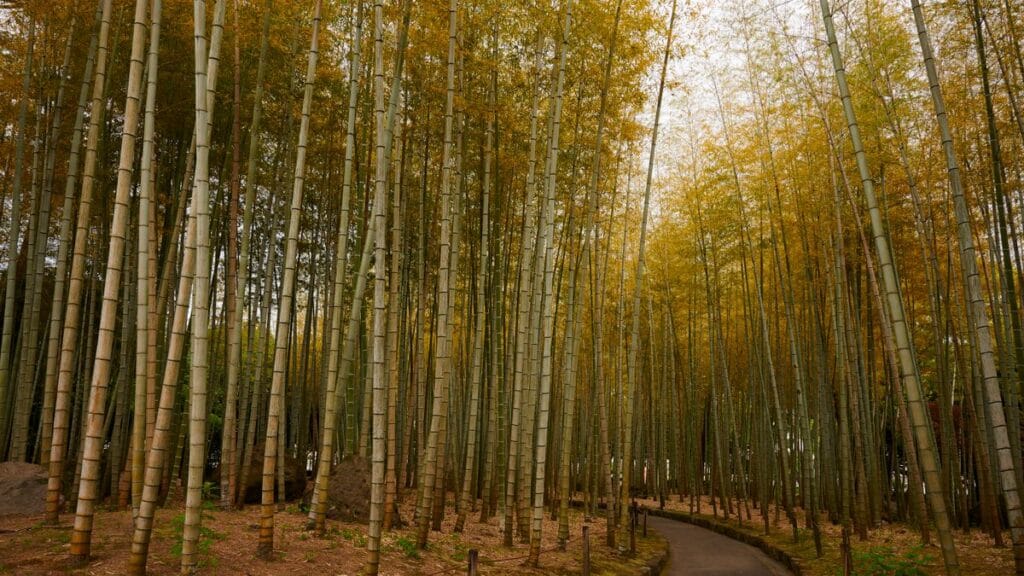
Private baths (貸切風呂 / kashikiri buro): The majority of Yufuin's ryokan offer private outdoor bath rooms (rotenburo) that can be reserved by the hour for exclusive use. This is the definitive Yufuin bathing experience — a cedar or stone outdoor bath, often with a view of Mount Yufu or a bamboo garden, completely private. Most ryokan include kashikiri buro access in their room rates.
Public baths: Shitanyu (下湯) and Nakaya (中谷) are small, simple, inexpensive public baths used primarily by local residents — the authentic counterpart to the ryokan experience.
Is Yufuin Worth the Hype? The Honest Verdict
Yes, if:
You stay overnight (the day-trip crowd departs by 5:00 PM, leaving the evening and morning to those who remain)
You visit October–December for morning mist season
You arrive at Kinrin-ko by 7:00 AM
You have booked a ryokan with a private outdoor bath
You approach the main street as a leisure browse rather than a destination
No, if:
You are doing a Saturday day trip during autumn foliage season and expecting a quiet mountain village
You need the experience to match the Instagram photographs that do not show the crowds
The gap between Yufuin's reputation and its peak-hours reality is the widest of any popular Japanese destination. Close that gap with timing, and Yufuin is exactly as beautiful as promised.
Recommended Base Hotels
Sanso Murata (山荘無量塔) (Luxury / from ¥60,000 per person): The most acclaimed ryokan in Yufuin — private cottages with outdoor baths in a forested setting. Considered among Japan's finest accommodation.
Yufuin Floral Village Cottage (Mid-range / from ¥25,000 per person): English-friendly, traditional atmosphere.
Yufuin Nottingham (Mid-range / from ¥18,000 per person): Good access and quality, well-reviewed by international visitors.
Planning where to stay in Kyushu & Okinawa? Browse our honest hotel picks and area guides.
🏨 Planning where to stay?
Every area guide on this site pairs with honest, station-by-station hotel picks. Start here: Oita Hotel Guides →