This article may contain affiliate links. If you book through them, we may earn a small commission at no extra cost to you.
On this page
- Introduction: The Japan That Doesn't Look Like Japan
- The Surf Culture: Miyazaki's Most Distinctive Character
- Aoshima (青島): The Subtropical Shrine Island
- Nichinan Coast (日南海岸): The Subtropical Drive
- Miyazaki Mythology: The Land Where the Gods Lived
- Miyazaki Food: Chicken, Mangoes, and Shochu
- The Phoenix Palms: Miyazaki's Visual Identity
- Recommended Base Hotels
Introduction: The Japan That Doesn't Look Like Japan
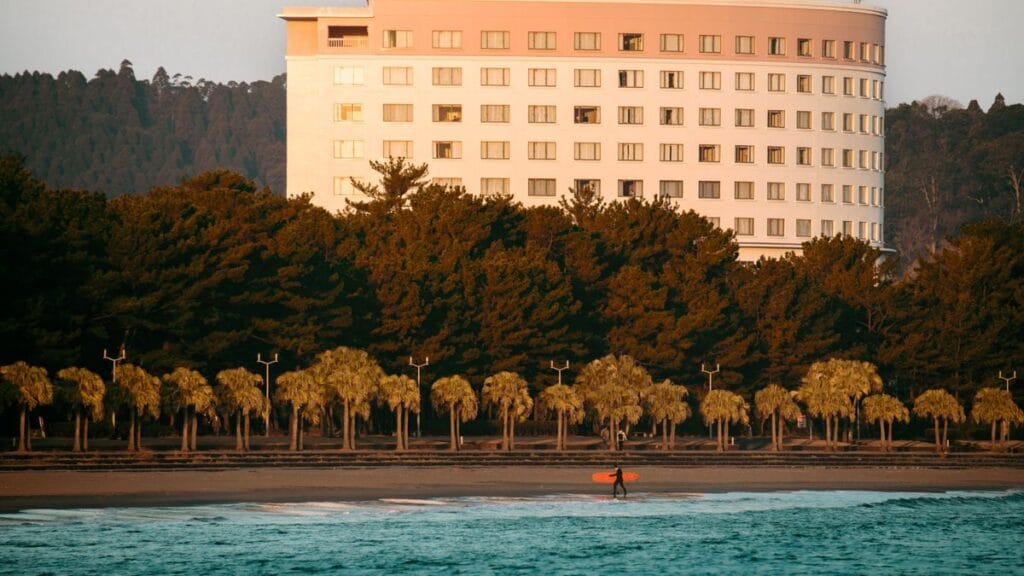
Japan is many things to its visitors — ancient temples, neon cities, volcanic mountains, snowbound ski resorts. Almost no one expects palm trees. Yet the coastline of Miyazaki Prefecture — the southeastern face of Kyushu, exposed to the Pacific — is lined with Washington palms (ワシントニアパーム) along its boulevards, the beaches receive Pacific swells that support one of Japan's most developed surf cultures, and the climate — one of the sunniest prefectures in Japan by hours of sunlight — produces a laid-back outdoor culture that feels, by Japanese standards, almost Mediterranean.
Miyazaki (宮崎) is the capital of this subtropical outlier — a mid-sized city of 400,000 that has been cultivating its beach culture and outdoor lifestyle for decades without particularly caring whether the rest of Japan or international visitors noticed. The result is a city with a strong local identity, genuine surf credentials, excellent food, and a sense of being exactly where it wants to be — which is refreshing in a country where many destinations are clearly oriented toward visitor approval.
The Surf Culture: Miyazaki's Most Distinctive Character
Miyazaki's Pacific coastline receives consistent swell from the open ocean — the same Pacific generating the waves that hit Hawaii and California arrives here having crossed the Pacific uninterrupted. The beaches of Kisakihama (木崎浜), Aoshima (青島), and the Hyuga Coast (日向灘) receive waves that rank among the most reliable in Japan.
Kisakihama Beach (木崎浜): Japan's Surf Mecca
Kisakihama — approximately 10 km south of Miyazaki city center — is Japan's most celebrated surf beach, regularly selected as the venue for national championship surfing events. The beach break here produces consistent, well-formed waves across a range of conditions, and the local surf culture — developed over decades — is mature and well-organized.
The beachside community of surf shops, cafés, and informal restaurants that has grown around Kisakihama creates an atmosphere unlike any other Japanese beach: casual, outdoor-oriented, with a social texture built around tide tables and swell forecasts rather than train schedules and office hours.
For non-surfers: The beach is excellent for swimming in summer, and surf lessons (typically ¥6,000–¥10,000 for a 2-hour beginner lesson with equipment) are available from multiple local schools for visitors who want to try. The waves at beginner-appropriate conditions — small, regular, well-spaced — make Kisakihama one of Japan's best locations to learn.
Aoshima (青島): The Subtropical Shrine Island
Aoshima — a small island connected to the mainland by a footbridge, covered in betel palms (ビロウ) and containing a Shinto shrine — is the most photogenic natural site near Miyazaki city. The island is ringed by Oni-no-Washboard (鬼の洗濯板) — "Devil's Washboard" — a remarkably regular pattern of sedimentary rock terraces exposed at low tide, the strata alternating between hard and soft layers and eroded into the characteristic washboard pattern by millennia of wave action.
The shrine within the island (Aoshima Jinja / 青島神社) is associated with Yamasachihiko (山幸彦) — the mythological prince who descended to the underwater palace of the sea god in a story fundamental to Miyazaki's mythological heritage (this area is considered the landscape where the myths of the gods preceding Japan's imperial line took place). The combination of subtropical vegetation, mythological significance, and geological spectacle makes Aoshima a genuinely unusual natural site.
- Access: 30 minutes by local bus from Miyazaki Station.
Nichinan Coast (日南海岸): The Subtropical Drive
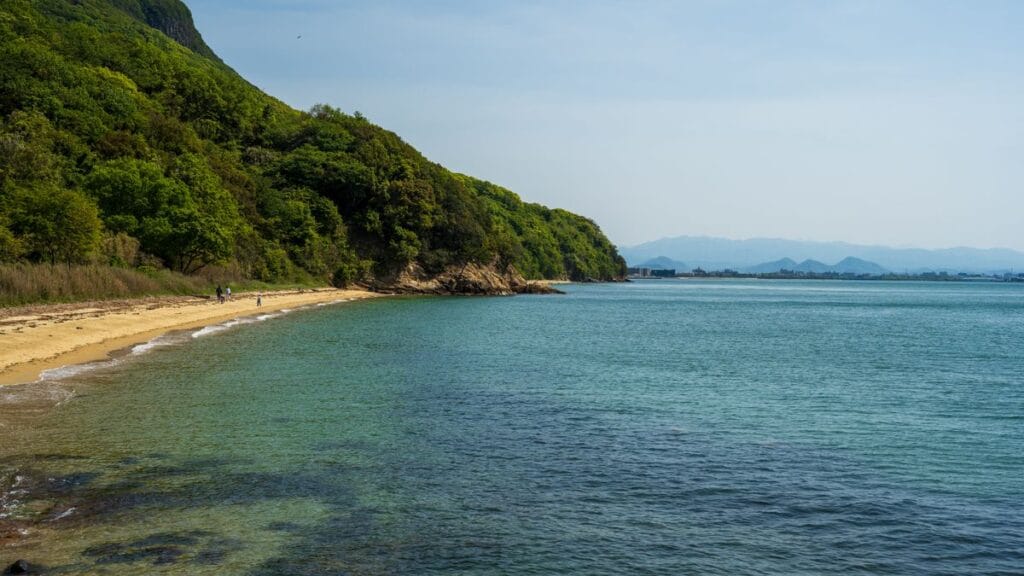
South of Aoshima, the Nichinan Coast runs for approximately 100 km along Miyazaki's Pacific shoreline — cliffs, coves, headlands, and the occasional beach, all backed by subtropical forest and with the Pacific visible at every point. Driving or cycling this coast is the quintessential Miyazaki outdoor experience.
Udo Shrine (鵜戸神宮): Built within the caves of a seaside cliff, Udo Shrine is one of the most dramatically positioned shrines in Japan — a complex of vermilion buildings occupying a coastal cave system accessible only by descending a stone staircase cut into the cliff face. The shrine's mythological connection to the Miyazaki coastal deity tradition and its extraordinary physical setting make it essential on the Nichinan Coast.
Cape Toi (都井岬): At the southern end of the Nichinan Coast, Cape Toi is a grassy headland where Misaki-uma (岬馬) — wild horses, a native breed that has roamed freely here since the 17th century — graze on the cliff tops above the Pacific. The sight of small, sturdy wild horses against the backdrop of the open ocean is one of Miyazaki's most unexpected and most memorable images.
Miyazaki Mythology: The Land Where the Gods Lived
Miyazaki Prefecture has an unusual claim in Japanese mythology: the Takachiho (高千穂) area — in the northern mountains of Miyazaki, approximately 2 hours from the city — is identified in the Kojiki and Nihon Shoki as the landing place of Ninigi-no-Mikoto (瓊瓊杵尊), the heavenly grandson who descended from the Plain of High Heaven to establish the divine foundation of the Japanese imperial line.
Takachiho Gorge (高千穂峡): The gorge carved by the Gokase River through volcanic basalt columns — the columns formed by rapid cooling of ancient lava flows into the characteristic hexagonal-prismatic shapes — is one of Japan's most dramatic geological formations. Rowing boats can be rented to explore the gorge from water level, with the basalt walls rising 80–100 meters above, the water a vivid green-blue, and the occasional waterfall descending from the cliff above.
Miyazaki Food: Chicken, Mangoes, and Shochu
Jidori Chicken (地鶏): Miyazaki's most famous food product — free-range chicken raised in the prefecture's outdoor agricultural environment. The Miyazaki Jidori brand is one of Japan's premium chicken designations, and the Chicken Nanban (チキン南蛮) — fried chicken served with a sweet-sour marinade and tartar sauce — is Miyazaki's most beloved local invention, now served throughout Japan but best in its home prefecture.
Hiyajiru (冷や汁): A cold miso soup with fish and vegetables poured over rice — Miyazaki's most distinctive traditional food. Appearing on menus throughout summer, hiyajiru has the cooling, refreshing quality appropriate to the prefecture's subtropical summers.
Miyazaki Mango: The prefecture produces Japan's finest mangoes — grown under nets in the subtropical climate, harvested when fully ripe (unlike imported mangoes), and commanding premium prices throughout Japan. Taiyo no Tamago (太陽のたまご) — "Egg of the Sun" — is the highest grade designation, with individual mangoes retailing for ¥5,000–¥15,000. The mango season (May–August) is worth scheduling a visit around.
The Phoenix Palms: Miyazaki's Visual Identity
The Washington palm (ワシントニアパーム) trees lining Tachibana-dori (橘通り) — Miyazaki's main downtown boulevard — were planted in the 1950s and have grown to heights of 15–20 meters, creating the subtropical boulevard silhouette that immediately distinguishes Miyazaki from every other Japanese city. Walking this boulevard is the most immediate experience of why Miyazaki's claim to "subtropical Japan" is genuine rather than promotional.
Recommended Base Hotels
Miyazaki Kanko Hotel (Mid-range / from ¥14,000): The city's established first-choice hotel, Tachibana-dori location.
Sheraton Grande Ocean Resort (Luxury / from ¥25,000): Phoenix Resort complex south of the city, adjacent to Kisakihama surf beach.
- Comfort Hotel Miyazaki (Budget / from ¥8,000): Miyazaki Station adjacent, reliable and convenient.
Planning where to stay in Kyushu & Okinawa? Browse our honest hotel picks and area guides.
🏨 Planning where to stay?
Every area guide on this site pairs with honest, station-by-station hotel picks. Start here: Miyazaki Hotel Guides →