This article may contain affiliate links. If you book through them, we may earn a small commission at no extra cost to you.
On this page
Introduction: The Bowl That Requires Speed
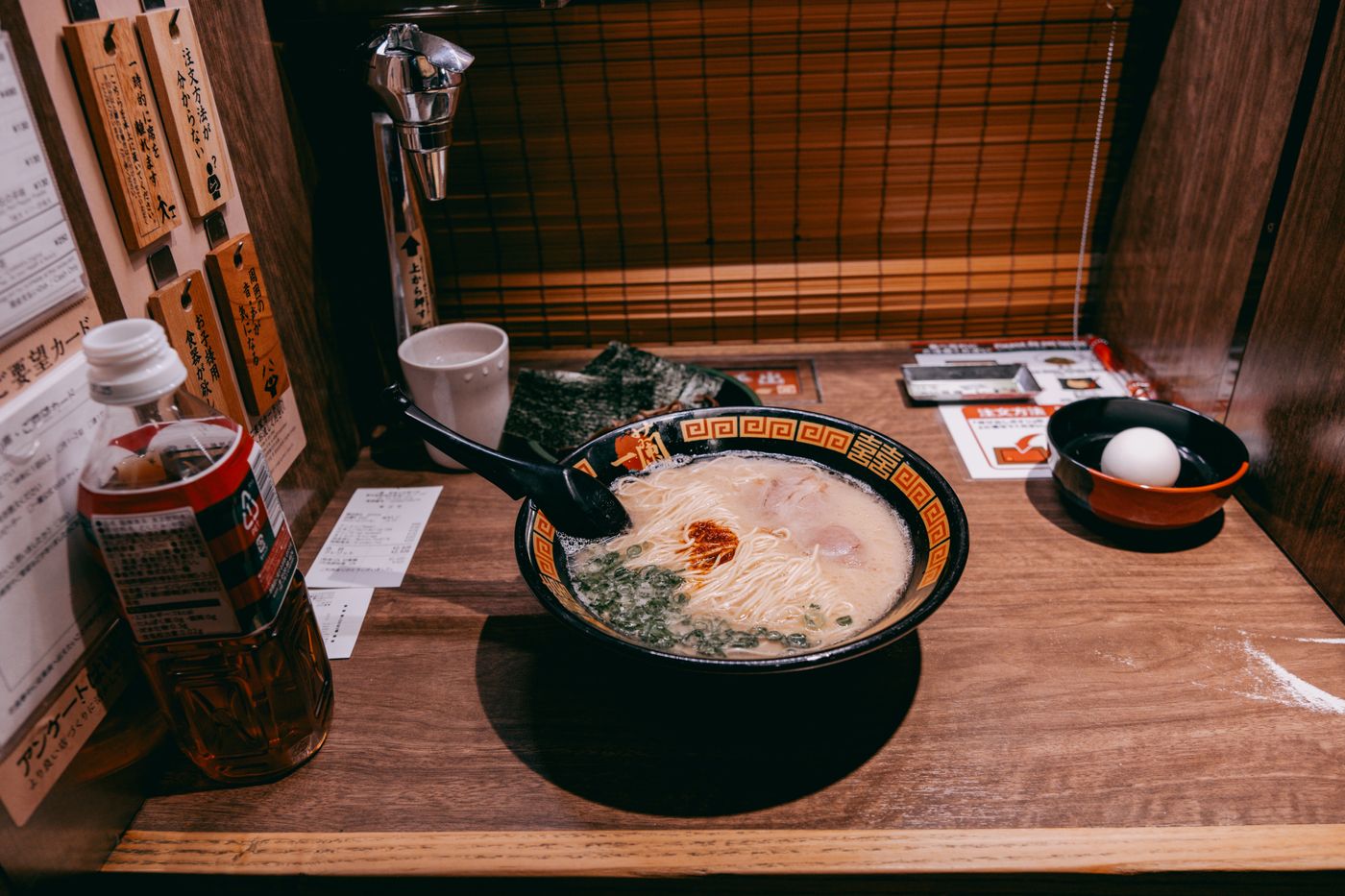
Hakata ramen (博多ラーメン) is Japan's fastest-consumed ramen. The statement is not speculative — the thin, straight noodles of Hakata ramen are cooked to extreme firmness (hard, or kata / かた, is the standard; harigane (針金 / wire-hard) and konaotoshi (粉落とし / just-shaken flour) exist for noodle texture maximalists) and begin softening in the hot tonkotsu broth within minutes of serving. The cultural norm of eating quickly — which exists to some degree in all ramen contexts — is in Hakata a genuine practical necessity.
The Tonkotsu Broth
Tonkotsu (豚骨 / pork bone broth) is produced by boiling pork trotters, knuckles, and back bones at high heat — a rolling boil maintained for 8–12+ hours. The high-heat boiling emulsifies the fat and collagen into the water, creating the characteristic milky-white opacity. Lower heat produces a clearer pork broth (chintan / 清湯) that is a different product; only sustained high heat produces the tonkotsu texture.
The chemical process: Collagen in the pork bones converts to gelatin at sustained high temperature. At room temperature, properly made tonkotsu broth will gel — a quality test that serious shops use to verify their broth's collagen content.
The smell: Tonkotsu broth has a characteristic smell that ranges from mild (young broth, short cooking) to intensely funky (extended cooking, more bone exposure). The most celebrated Hakata shops produce broth with the funkiest smell — considered the mark of the most thorough extraction.
How to Order in a Hakata Ramen Shop
The ordering process in a proper Hakata ramen shop involves several customization decisions:
Noodle firmness (麺の硬さ):
Yawa-yawa (やわやわ / very soft)
Yawa (やわ / soft)
Futsuu (普通 / standard)
Kata (かた / firm) — the Fukuoka default
Barikata (バリかた / extra firm)
Harigane (針金 / wire-hard)
Konaotoshi (粉落とし / essentially raw — only recommended for the very experienced)
- Broth richness (濃さ): Some shops offer thin to thick broth options.
- Fat content (脂): The amount of back fat floating on the surface — shops offer levels from none to extra.
- Seasoning (味の濃さ): Light to heavy tare concentration.
The Kaedama System
Kaedama (替玉) — the Hakata innovation — allows ordering additional noodles to be added to your remaining broth:
When to call kaedama: When approximately 2–3 spoonfuls of broth remain and you have finished your noodles. Too early and the kaedama sits in too much broth; too late and there is insufficient broth to flavor the additional noodles.
The call: "Kaedama hitotsu! (替玉一つ!)" — "One kaedama!" — called to the cook at the counter. The additional noodles arrive within 30 seconds in a small colander and are dropped directly into your bowl.
Noodle specification: A second kaedama can specify a different firmness from the first — many experienced diners order kata for the first serving and barikata for the kaedama.
The Fukuoka Ramen Geography
Nagahama area (長浜): Where Hakata tonkotsu ramen originated — the fish market district whose workers required quick, sustaining meals — the market moved here in 1955, and the ramen style grew up around it. The Nagahama ramen style here is slightly lighter than the main city style, served faster, and consumed at even greater speed.
Fukuoka Yatai (屋台): The open-air food stalls that line the Nakasu riverside — as described in the Fukuoka city article, several yatai serve tonkotsu ramen, and eating a bowl at a yatai counter with the evening city around you is the most atmospheric version of the Hakata ramen experience.
The Toppings: Minimal Is Correct
Authentic Hakata ramen has few toppings: chashu pork, green onion, pickled ginger (紅生姜 / beni shoga), sesame seeds, and black garlic oil (黒マー油 / kuro ma-yu) (at shops that offer it). The minimalism is deliberate — the broth is the meal; toppings are accent rather than substance.
The condiment tray: Most Hakata ramen shops provide a condiment tray with pickled ginger, sesame seeds, karashi-takana (辛し高菜 / spicy pickled mustard greens), and sometimes crushed garlic. Adding these at intervals through the meal — rather than all at the beginning — is the local practice.
Recommended Shops
Shin-Shin (しんしん): Most consistently acclaimed by locals — a cleaner, less funky version of the style that demonstrates what restraint in tonkotsu can achieve.
Ippudo (一風堂): The Fukuoka original — the Fukuoka branches are significantly different from the international chain versions.
Nagahama Number One (長浜ナンバーワン): The original Nagahama market area stall that gives the style its historical claim.
Planning where to stay in Kyushu & Okinawa? Browse our honest hotel picks and area guides.
🏨 Planning where to stay?
Every area guide on this site pairs with honest, station-by-station hotel picks. Start here: Fukuoka Hotel Guides →