This article may contain affiliate links. If you book through them, we may earn a small commission at no extra cost to you.
On this page
Introduction: The City That Japan Opened to the World
On March 31, 1854, the Convention of Kanagawa — negotiated with Commodore Perry’s squadron and signed at Yokohama — opened two ports to American ships: Shimoda and Hakodate. This moment ended over 200 years of Japan's closed-country policy and began the international engagement that would transform the country over the following decades.
Hakodate (函館) was thus one of the first Japanese cities to experience sustained international contact in the modern era, and the effects are still visible in its physical fabric: Western-style consular buildings on the hillside above the harbor, a Russian Orthodox church whose green domes define the Motomachi skyline, a British consulate preserved as a museum, and a overall architectural character that the rest of Hokkaido — developed later and with less international involvement — simply does not have.
Hakodate is also, for reasons partly climatic and partly geographical, home to the best squid in Japan.
The Morning Market (朝市): Hakodate's Daily Ritual
Hakodate Morning Market (函館朝市) — operating from approximately 5:00 AM to noon daily — is the largest and most famous morning market in Hokkaido, occupying a complex of covered buildings immediately adjacent to Hakodate Station. The market's approximately 250 stalls represent the full spectrum of Hokkaido's marine produce, with particular emphasis on:
Live squid (活イカ): The definitive Hakodate food experience — squid caught the previous night in Hakodate Bay are brought live to the market. Several market restaurants and stalls offer ikizukuri (活き造り / live squid sashimi) — the squid is selected by the customer, prepared tableside while still alive, and served with the still-moving translucent flesh alongside the intact squid body (which continues exhibiting movement). This is one of the most direct farm-to-table experiences available in Japan, and the sweetness and texture of immediately fresh squid is unlike any other seafood experience.
Kaisendon (海鮮丼 / Seafood Rice Bowl): The morning market's most popular breakfast option — a bowl of warm rice topped with the freshest possible selection of local seafood. The combination typically includes uni (sea urchin), ikura (salmon roe), and the relevant seasonal shellfish, with the squid option adding the market's signature ingredient.
Hairy crab (毛ガニ): A Hokkaido specialty — a dense-meat crab variety whose culinary value is recognized throughout Japan. At the morning market, live hairy crabs in tanks can be selected and prepared to order.
Practical note: The morning market is best experienced between 6:00 AM and 8:00 AM — by 9:00 AM, the most interesting products are beginning to sell out and the tourist volume is increasing. The market's "ikizukuri experience" breakfast is one of Japan's most memorable food experiences, and the specific squid freshness available here is genuinely unavailable elsewhere.
The Ropeway and Hakodate Night View (函館山)
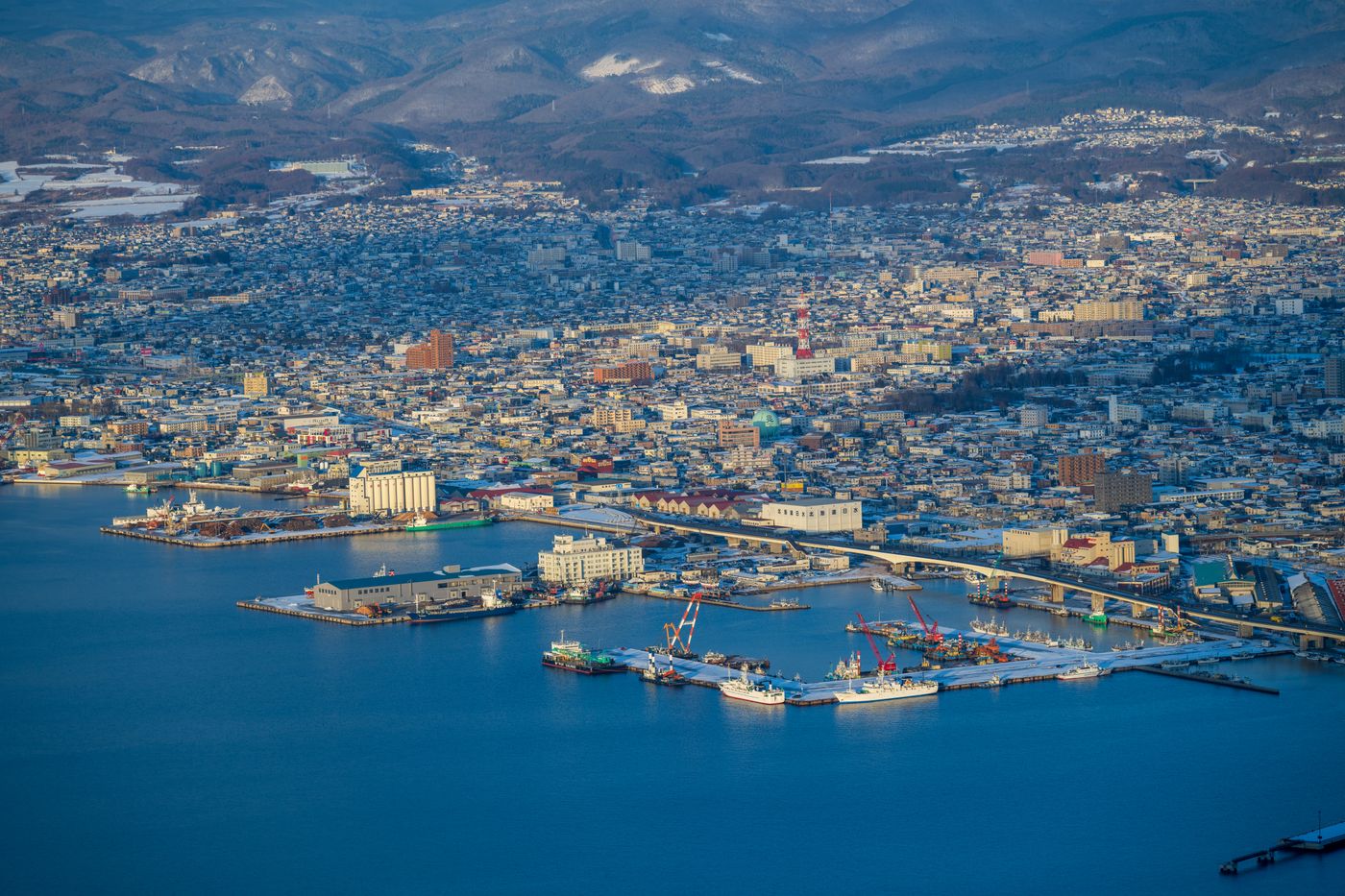
Hakodate Night View (函館夜景) — the view from Mount Hakodate (334 meters) over the city below — is classified as one of Japan's traditional three great night views (alongside Nagasaki and Kobe). The reason is specific geography: Hakodate is built on a narrow isthmus between two bays, and from the summit, the lights of the city spread in a figure-eight or hourglass shape — the land narrowing to approximately 500 meters at the waist before widening again to the port area — creating a composition unavailable from any other major Japanese city.
The Ropeway (函館山ロープウェイ): Operating from the Motomachi district below to the summit in approximately 3 minutes (round trip roughly ¥1,500–¥1,800 — check current fares), the ropeway is the standard access route in the evening. The summit area has multiple viewing platforms on all sides, with the canonical night view facing east toward the city center.
Timing: The most dramatic view is during twilight — approximately 20–30 minutes after sunset — when the sky still holds a gradient of color above the horizon and the city lights are fully on below. This creates the most complete dynamic range of visual interest. Arriving 40 minutes before sunset and staying through the full dark period gives the complete experience.
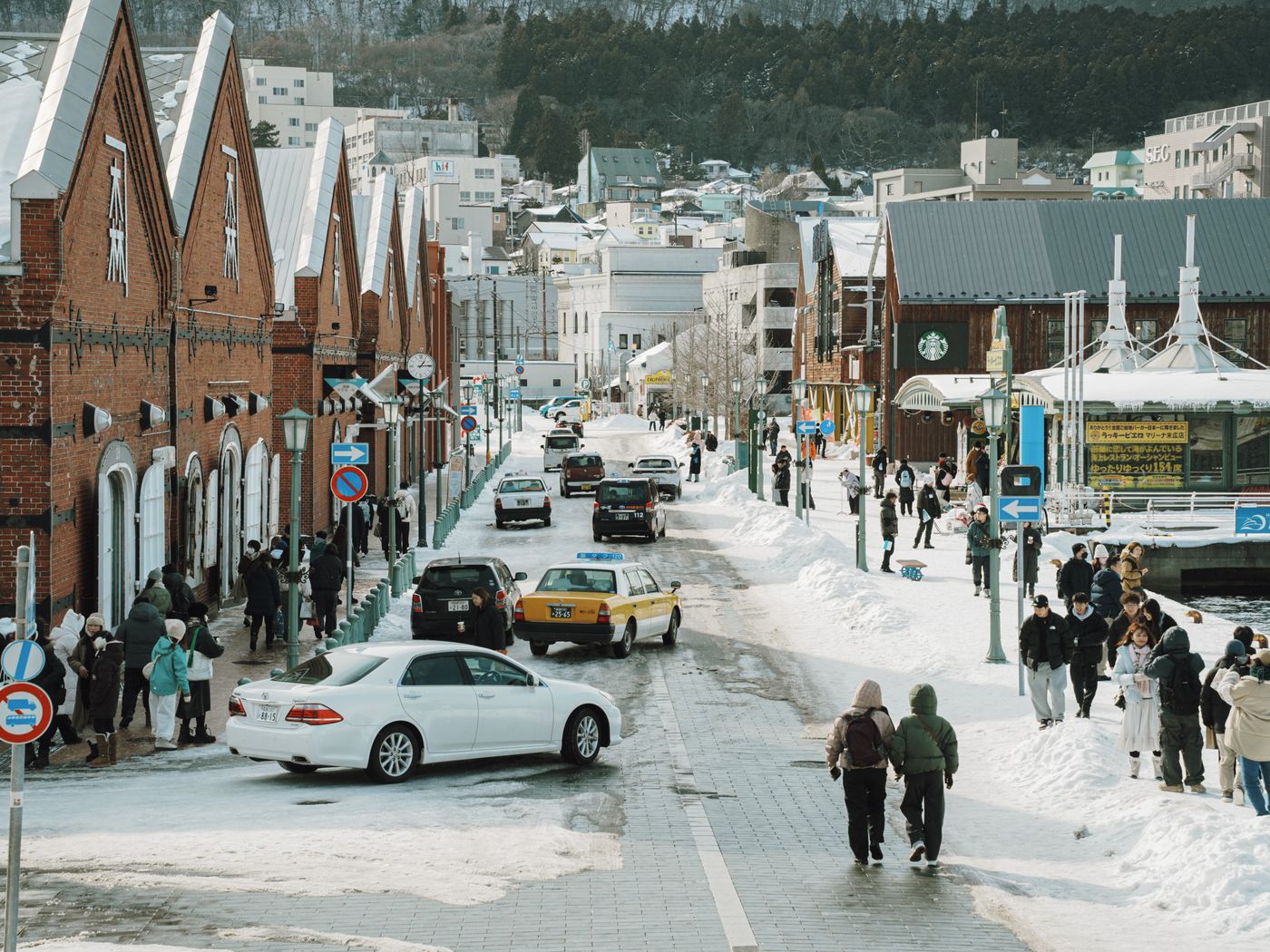
Walking alternative: During daylight hours, several hiking trails ascend Mount Hakodate from the Motomachi district. The most atmospheric is the Chayagoshi Trail (茶屋越コース), passing through the historic Hakodate Fort earthworks before ascending to the summit.
Goryokaku (五稜郭): The Star Fort
Goryōkaku (五稜郭) — "Five-Pointed Citadel" — is Japan's first Western-style star fort, built between 1857 and 1866 using Dutch engineering principles to defend Hakodate against coastal attack. The fort's shape — a regular five-pointed star with defensive bastions at each point — was a European military design that maximized coverage from defenders while minimizing dead angles.
The fort achieved brief historical fame as the site of the Battle of Hakodate (箱館戦争) in 1868–1869 — the final battle of the Meiji Restoration, where Tokugawa loyalists made their last stand against the new imperial government's forces. The loyalist leader Enomoto Takeaki (榎本武明) surrendered in May 1869, ending the last resistance to the new Meiji government.
Viewing Goryōkaku: The star shape of the fort is only visible from above — the Goryōkaku Tower (五稜郭タワー) adjacent to the fort provides an observation deck (¥900) with the definitive overhead view. In cherry blossom season (late April to early May), the fort's earthwork walls are lined with approximately 1,600 cherry trees that bloom simultaneously — the combination of the star shape and the pink blossom, visible from the tower, is one of Hokkaido's most celebrated spring views.
Motomachi (元町): The Western Architecture District
The hillside district of Motomachi — climbing from the harbor to the slopes of Mount Hakodate — preserves the architectural legacy of Hakodate's international era. Several significant buildings remain:
Hakodate Orthodox Church (函館ハリスト正教会): Built in 1916, the green-domed Russian Orthodox church is the most visually distinctive building in Hakodate's skyline. The interior is richly decorated with Russian Orthodox iconography, and the church's bells — rung on Sunday mornings — are a characteristic sound of the Motomachi neighborhood.
Old Public Hall of Hakodate Ward (旧函館区公会堂): An 1910 building in American colonial style, its bright yellow and blue exterior occupying the highest point of the Motomachi district with panoramic harbor views. The interior has been preserved to period and is open to visitors.
Former British Consulate (旧イギリス領事館): A 1913 building now operating as a museum of Hakodate's international history, with a café serving Victorian-style afternoon tea.
Hakodate Squid: The Complete Picture
Hakodate's squid supremacy deserves its own section. The Surume Ika (スルメイカ / Japanese flying squid) caught in Hakodate Bay during the summer season (June–October) are considered by seafood specialists to be Japan's finest — a consequence of the specific water temperature and food availability in the bay during this period.
The squid fishing boats (イカ釣り漁船): On summer evenings, a specific night-fishing technique illuminates Hakodate Bay with the lights of dozens of squid fishing boats — the bright blue-white lights are visible from the mountain ropeway as a parallel constellation on the water's surface. This image — the city lights on the shore, the squid boats on the water — is one of the most distinctive night views in Hokkaido.
Ika Somen (イカそうめん): Squid sliced into fine noodle-like strips, served with dipping sauce — one of the most elegant presentations of Hakodate's squid culture.
Recommended Base Hotels
- Hakodate Hills (Luxury / from ¥25,000): Motomachi location, Mount Hakodate ropeway access.
JR Hotel Clement Hakodate (Mid-range / from ¥15,000): Hakodate Station direct connection, morning market access.
La Vista Hakodate Bay (Mid-range / from ¥18,000): Bayview breakfast with morning crab — the most celebrated breakfast hotel in Hakodate.
Planning where to stay in Hokkaido? Browse our honest hotel picks and area guides.
🏨 Planning where to stay?
Every area guide on this site pairs with honest, station-by-station hotel picks. Start here: Hokkaido Hotel Guides →