This article may contain affiliate links. If you book through them, we may earn a small commission at no extra cost to you.
On this page
Introduction: The Loudest Thing in Japan
Japanese baseball fans are, by international comparison, extraordinary. In a country known for reserved public behavior, the baseball stadium is where Japan's capacity for collective enthusiasm finds its fullest expression — and the result is one of the most participatory and technically impressive spectator experiences in world sport.
Nippon Professional Baseball (NPB) — Japan's professional league — has been running since 1950 and has developed a fan culture that differs substantially from American Major League Baseball (from which it originates) and from the football supporter cultures of Europe. The specific combination of organized cheering groups, synchronized percussion, team songs for every player, and the absolute commitment of the ōendan (応援団 / cheering squad) creates a stadium atmosphere unlike anything in professional sport elsewhere.
Understanding the Fan Culture
The Ōendan (応援団): Japan's Organized Cheering
Every NPB team has an official cheering organization (応援団 / ōendan) — groups of fans who stand throughout the game in the designated cheering sections (応援席), conducting the crowd in synchronized cheers, songs, and instrumental accompaniment. The ōendan section is not for passive observers.
The trumpets and drums: The cheering section's sound comes from a combination of trumpets (トランペット), drums (太鼓), and often other brass instruments playing the specific ouen-ka (応援歌 / cheering songs) composed for each team and for each individual player. Every batter has their own song; when they walk to the plate, the relevant song begins immediately and continues until the at-bat is resolved.
The synchronized cheering: Every cheer in the ōendan section is conducted — the leader (団長 / danchō) signals the crowd through gestures, and the entire section responds in unison. The coordination achievable with 5,000 people all following the same leader's rhythm is impressive regardless of the underlying sport.
The Towel Wave and Custom Chants
NPB teams have developed specific cheering traditions that have no MLB equivalent:
The towel wave (タオルまわし): Team-colored towels (sold at stadium merchandise stands) are waved over the head in circular motions in synchronization during key moments — a visual effect that, when performed by the entire home section simultaneously, is striking.
Player-specific songs: The quality and enthusiasm of a player's dedicated song is considered a mark of their standing with the fans. The most beloved players have songs that the entire stadium knows and joins.
The Best Stadium Experiences
Hanshin Koshien Stadium (阪神甲子園球場): The Cathedral
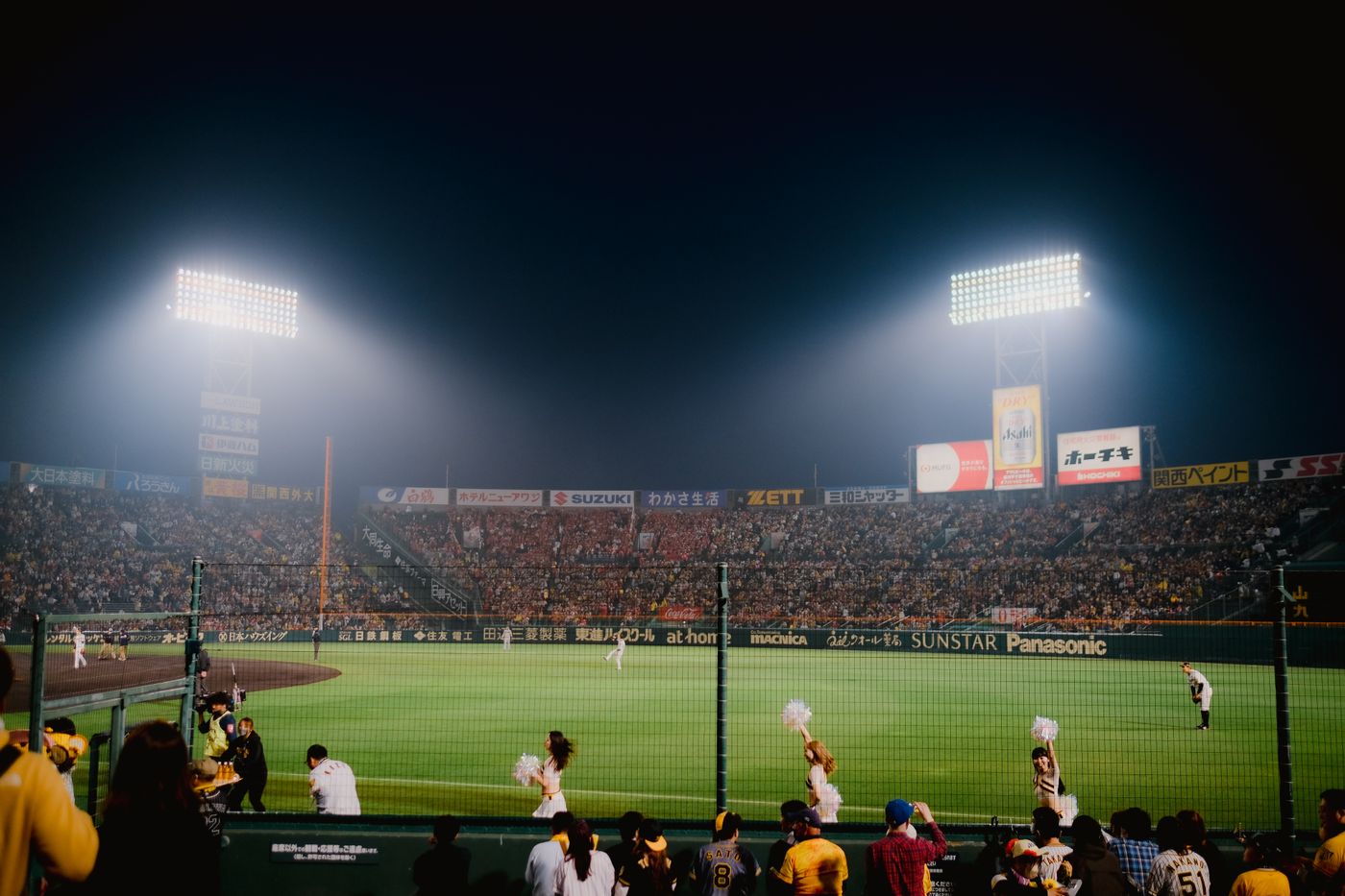
Koshien — home of the Hanshin Tigers (阪神タイガース) in Nishinomiya (between Osaka and Kobe) — is Japan's most historically significant baseball venue: an ivy-covered concrete stadium opened in 1924 — older than any professional ballpark in Japan and a contemporary of America’s classic parks (Fenway 1912, Wrigley 1914). Koshien is also the venue for the National High School Baseball Championship (甲子園大会) — Japan's most watched amateur sports event, broadcast live nationally for two weeks every August.
The Tigers' fan culture is the most intense in NPB — the organized cheering in the stands, the yellow happi coats worn by thousands, and the specific Kansai energy of the crowd produce an atmosphere that visiting American Major Leaguers have consistently described as the most intense crowd experience in baseball.
The sake and beer: Koshien's beer vendors (うりこ / uriko) carry casks of draft beer on their backs and pour from taps — the spectacle of a smiling vendor crouching to pour from a back-mounted keg while maintaining eye contact and conversation is a Koshien institution.
Mazda Zoom Zoom Stadium (Hiroshima): The Intimate Park
Mazda Zoom Zoom Stadium Hiroshima — opened in 2009 for the Hiroshima Toyo Carp (広島東洋カープ) — is considered Japan's finest modern baseball stadium: a design that brings the stands close to the field, uses natural grass, and creates the intimate atmosphere of a classic ballpark within a contemporary structure.
The Carp fan culture is particularly worth experiencing — the team's decades of limited resources (the Carp is the only owner-operated team in NPB, without major corporate backing) created a fan relationship of unusual intensity. The red sea (赤の海) of Carp fans in full red costume and the cheering section's organized passion represent Japanese baseball fandom at its most devoted.
Tokyo Dome (東京ドーム): Yomiuri Giants
The Tokyo Dome — Japan's first domed stadium, home of the Yomiuri Giants (読売ジャイアンツ) — provides the most accessible and most internationally organized experience for foreign visitors. The Giants' fan section (in right field) maintains the full ōendan experience, and the stadium's proximity to Suidobashi Station (Tokyo Metro Marunouchi Line, JR Chuo/Sobu Line) makes it the easiest stadium to reach from central Tokyo.
Practical Attendance Guide
Food: Stadium food in Japan is considerably more interesting than its counterparts elsewhere. In addition to standard baseball fare (hot dogs, popcorn), each stadium's vendors offer regional specialties — Hiroshima-style okonomiyaki at Mazda Stadium, Osaka-style kushikatsu at Koshien, various regional delicacies at stadiums throughout Japan.
Buying tickets: International visitors can purchase tickets through the Klook platform (English-language, credit card accepted) or directly through team websites (Japanese language, but manageable with translation). Bleacher seats (外野席 / gaiyaseki) are the least expensive and the most active for fan culture participation.
Alcohol and food at seats: Bringing outside food and drink into Japanese stadiums is generally permitted — an important difference from American baseball where this is restricted.
Recommended Base Hotels
- Koshien area: Nishinomiya's several business hotels, or Osaka/Kobe city hotels (30 minutes by rail).
- Tokyo Dome: Hotels near Suidobashi Station.
- Hiroshima: City center hotels near Hiroshima Station.
🏨 Planning where to stay?
Every area guide on this site pairs with honest, station-by-station hotel picks. Start here: Hotel Guides by Station →