This article may contain affiliate links. If you book through them, we may earn a small commission at no extra cost to you.
On this page
Introduction: The Ocean Doing Something Impossible
Twice daily, as the tide changes in the Naruto Strait (鳴門海峡) — the narrow channel between Awaji Island and the Shikoku mainland — something happens that most people wouldn't believe without seeing. The tidal flow between the Pacific Ocean and the Seto Inland Sea, forced through a channel barely 1.3 kilometers wide, generates current speeds of up to 20 kilometers per hour. These currents, colliding with the seabed topography and with each other, create whirlpools (渦潮 / uzushio) that reach diameters of up to 20 meters — the largest tidal whirlpools in the world.
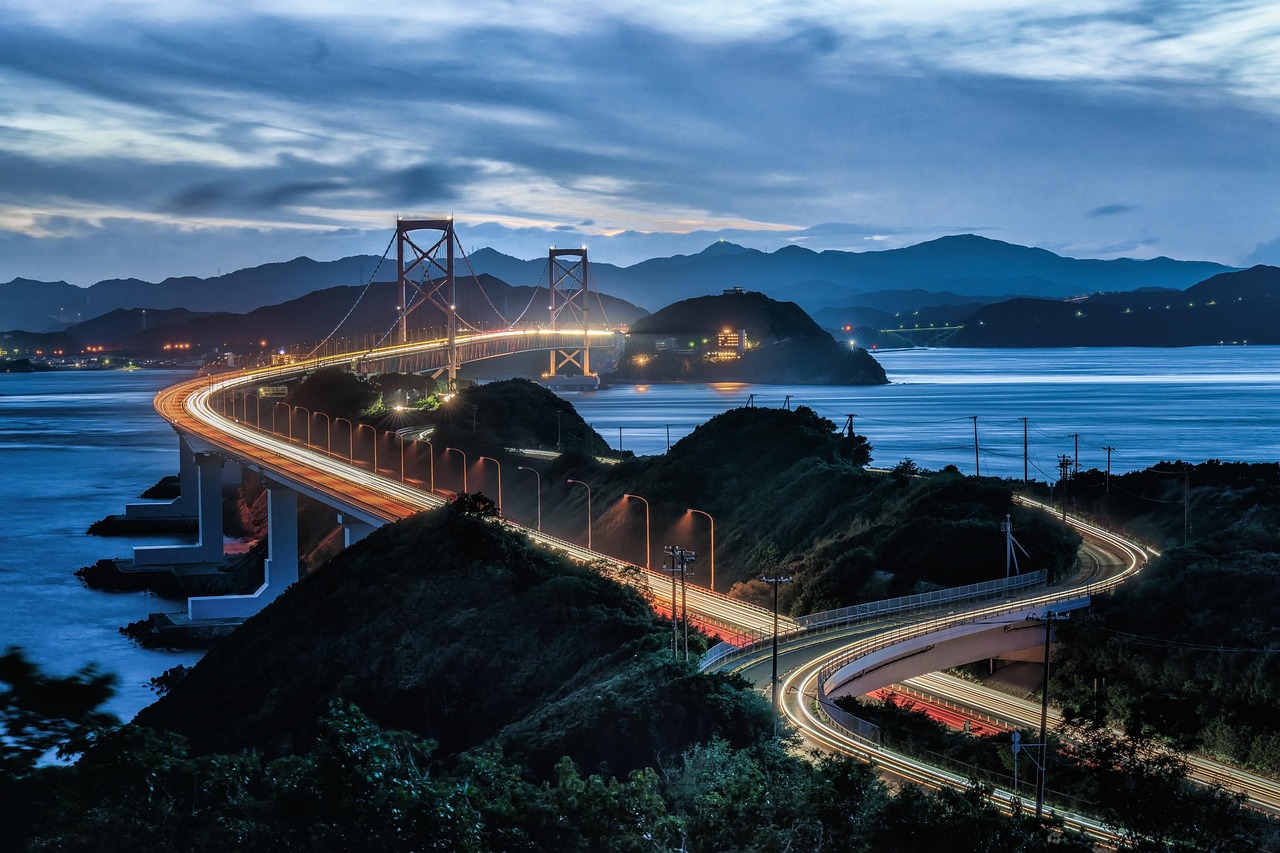
The Naruto Whirlpools (鳴門の渦潮) are not a gentle natural curiosity. Standing on the observation walkway of the Ōnaruto Bridge (大鳴門橋) directly above the strait, watching the water below organize itself into spinning discs of white water 20 meters across, with the roar of the current audible above the bridge noise, is a genuinely disorienting experience — the ocean doing something that looks more like a special effect than a natural phenomenon.
Understanding the Whirlpools: The Science
The Naruto Strait is the connection between the Seto Inland Sea (瀬戸内海) — which has a tidal range of approximately 1.5 meters — and the Pacific Ocean (太平洋) — which has a tidal range of approximately 1.9 meters. The difference in water level between the two bodies creates a pressure differential that drives water through the strait at each tide change.
The key factors that produce the whirlpools:
Narrow channel: 1.3 km width forces the water to accelerate
Depth variation: The seabed rises and falls abruptly, creating turbulence
Opposing currents: Flood tide and ebb tide flows meet and interact
Volume: Approximately 6 million tons of water pass through the strait at each tide change
The result is a chaotic turbulent zone where surface water flows in multiple directions simultaneously, and the physics of fluid dynamics produce the characteristic circular structures of the whirlpools.
Size: The largest whirlpools occur during the greatest tidal differentials — the spring tides that occur twice monthly at new and full moon. At these times, whirlpools of 20 meters diameter are documented. At other times, whirlpools of 10–15 meters are typical.
Viewing Option 1: Uzu no Michi (渦の道) — The Bridge Walkway
Uzu no Michi (渦の道) is a 450-meter enclosed walkway inside the lower deck of the Ōnaruto Bridge, running directly above the Naruto Strait. The walkway ends in a series of observation rooms with windows and glass floor panels that look directly down 45 meters to the water below.
The glass floor experience — standing above a 20-meter whirlpool with nothing between you and the spinning water below but a glass panel — is viscerally impressive. The roar of the current is audible through the structure, and the visual of the water organizing itself into spinning forms directly beneath your feet is unlike any other natural observation experience in Japan.
Entry: ¥510 (adult) · Hours: 9:00 AM–6:00 PM Mar–Sep, 9:00 AM–5:00 PM Oct–Feb, from 8:00 AM in peak holiday weeks (checked July 2026)
Viewing Option 2: Sightseeing Boat
Kankou-sen (観光船) — sightseeing boats — operate from Naruto Park at the base of the Ōnaruto Bridge on the Tokushima side, entering the strait directly to observe the whirlpools at water level.
The boat experience is fundamentally different from the bridge walkway — you are in the whirlpools rather than above them, and the water's behavior at surface level (the current lines, the smaller subsidiary whirlpools, the turbulent interface between opposing flows) is visible in a way the elevated walkway cannot provide.
Operator options:
Uzushio Kanchosen (うずしお観潮船) "Wonder Naruto": large sightseeing boat, approximately 30 minutes, ¥1,800
Aqua Eddy (アクアエディ): The same operator's semi-submersible boat (¥2,400, reservation required) with an underwater observation room that provides views of the whirlpools from below the surface — the most unusual viewing option and particularly compelling at peak tidal flow times
Timing: When to Go
The whirlpools are most impressive during spring tides — the tidal conditions that occur twice monthly around the new and full moon, when the tidal differential is greatest. Outside of spring tides, the whirlpools are smaller but still impressive.
Optimal timing within any day: The strongest currents (and largest whirlpools) occur within roughly 1.5 hours either side of high tide and low tide — when the water level difference between the Pacific and Inland Sea is greatest and the flow through the strait is at maximum velocity.
The Naruto City Tourism Association and the Uzu no Michi website publish daily tidal flow predictions and estimated peak whirlpool times — checking this before visiting is strongly recommended.
Naruto City: The City Beyond the Whirlpools
Naruto City itself offers several additional points of interest:
Ōtsuka Museum of Art (大塚国際美術館): One of Japan's largest art museums, housed in underground tunnels in the Naruto hillside, presenting ceramic reproductions of the world's most important artworks — 1,000 works recreated at original scale in fired ceramic. The Sistine Chapel ceiling, the entire Pompeii fresco cycle, Monet's Water Lilies series, all reproduced at full scale and permanent (ceramic is theoretically undegradable). The concept is controversial among art purists but the execution is extraordinary.
The Ohenro Connection: Naruto is Temple 1 (Ryōzen-ji / 霊山寺) of the Shikoku 88 Temple Pilgrimage — visitors to the Naruto Whirlpools who have any interest in the Ohenro pilgrimage can begin (or complete) the circuit here, visiting the starting temple and purchasing pilgrim equipment before or after seeing the whirlpools.
Recommended Base Hotels
Aoawo Naruto Resort (Upper mid-range / from ¥18,000): A seaside resort hotel a short drive from Naruto Park and the boat departure point — the most convenient full-service base for whirlpool viewing.
JR Hotel Clement Tokushima (Mid-range / from ¥12,000): at Tokushima Station, excellent access to both Naruto and the Ohenro pilgrimage.
Planning where to stay in Shikoku? Browse our honest hotel picks and area guides.
🏨 Planning where to stay?
Every area guide on this site pairs with honest, station-by-station hotel picks. Start here: Hotel Guides by Station →