
This article may contain affiliate links. If you book through them, we may earn a small commission at no extra cost to you.
On this page
Introduction: Japan's Most Underrated Food City
Nagoya (名古屋) is Japan's fourth-largest city — the capital of Aichi Prefecture, the center of Japan's automotive manufacturing heartland (Toyota's headquarters is 30 minutes away), and the city that most international visitors pass through without stopping. It is also, by a significant margin, Japan's most underrated food destination.
The distinctive culinary tradition of Nagoya — collectively known as Nagoya-meshi (名古屋めし / Nagoya food) — is built on a specific and unapologetic flavor philosophy: rich, sweet, and deeply fermented. The Hatcho miso (八丁味噌) that defines Nagoya's cooking is a red miso aged for two years or more in wooden barrels, developing a depth and intensity that standard miso cannot approach. This miso appears in forms that would be extraordinary in any other Japanese culinary context: poured over a breaded pork cutlet (miso katsu), used as a broth for chicken wings (tebasaki), mixed with sesame paste as a condiment, and cooked into udon noodles with no other flavoring required.
The reaction of first-time visitors to Nagoya-meshi — usually surprise at the intensity of flavor, followed quickly by enthusiasm — explains why the city's food culture has developed such strong local pride. Nagoya residents know they have something special, and they are correct.
Nagoya-meshi: The Complete Food Guide
Miso Katsu (味噌カツ)
Miso katsu is Nagoya's most internationally recognizable dish — a breaded, deep-fried pork cutlet (tonkatsu) served with a thick, dark red Hatcho miso sauce poured over the top. The sauce — reduced Hatcho miso with sugar and mirin — is simultaneously sweet, deeply fermented, and umami-rich in a way that transforms the familiar tonkatsu format into something entirely different.
Where to eat: Yabaton (矢場とん) — founded in 1947, operating multiple Nagoya locations — is the essential reference point. The original location near the main Yaba-cho bus terminal has been serving miso katsu to long queues since the postwar period, and the experience of eating at a Yabaton counter — the noise, the speed of service, the smell of frying and miso — is part of what miso katsu means in Nagoya.
Tenmusu (天むす)
Tenmusu is a rice ball (おにぎり / onigiri) with a small shrimp tempura as the filling — the combination of crispy tempura with the soft rice, the nori wrapper adding a layer of flavor. Invented in Tsu City (Mie Prefecture) but adopted so completely by Nagoya that it is now considered a Nagoya-meshi staple.
The quality of tenmusu depends critically on the tempura's freshness — it should be eaten within hours of preparation, making the Nagoya market stalls and specialist shops (particularly Chiyo (千寿), the most celebrated producer) the correct place to experience it.
Hitsumabushi (ひつまぶし)
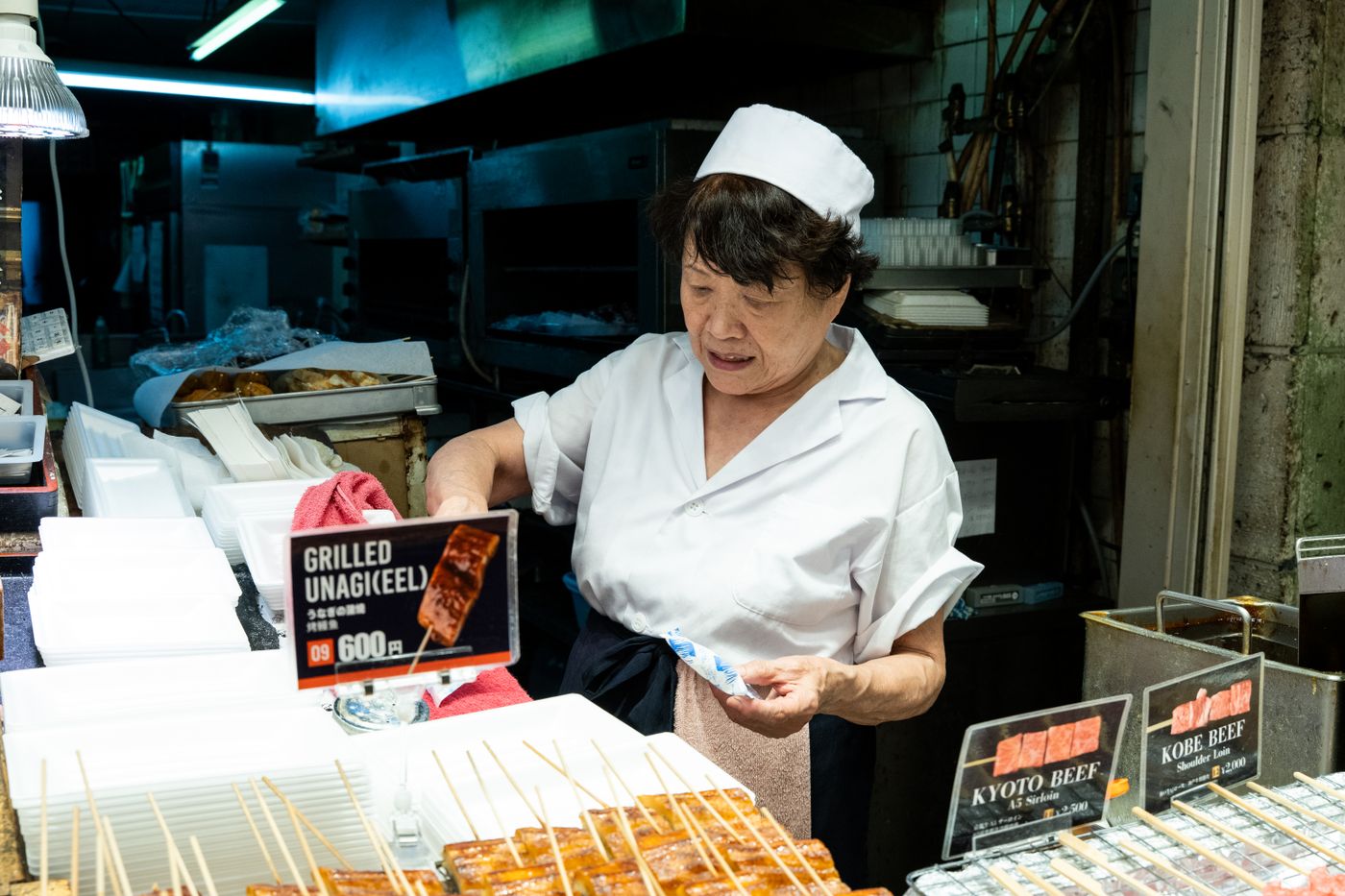
Hitsumabushi is Nagoya's most sophisticated food — unagi (eel) prepared in the Nagoya style (grilled directly without the preliminary steaming used in Tokyo-style preparation, giving a crispier texture and more direct charcoal flavor) and served over rice in a wooden tub (ohitsu / お櫃).
The unique element of hitsumabushi is the three-stage eating ritual: first, eat a portion straight from the tub. Second, eat a portion with condiments (wasabi, green onion, nori). Third, pour dashi (broth) over the remaining rice and eel to create a kind of ochazuke — the dashi softening the textures and integrating the flavors. The same ingredients become three different dishes through the progression.
Where to eat: Atsuta Horaiken (あつた蓬莱軒) — operating since 1873, located near Atsuta Shrine — is considered the originator and standard-bearer of hitsumabushi. Queues form before opening; reservation or early arrival is essential.

Kishimen (きしめん)
Kishimen is Nagoya's flat udon noodle — wider and thinner than standard udon, with a distinctive silky texture from the width-to-thickness ratio. Served in a broth colored and flavored with Hatcho miso (the red variety) or sometimes a lighter soy-based broth, kishimen has been the working person's everyday noodle in Nagoya for centuries.
Station platform kishimen: One of Nagoya's most specifically local food experiences — Nagoya Station's platform kishimen stands (きしめんスタンド) serve fresh kishimen in broth from simple counter operations on the Shinkansen platforms. The standing-and-eating character, the speed of service, and the specific atmosphere of a platform food stand that has been operating in the same space for decades make this a distinctly Nagoya experience.
Nagoya Cochin (名古屋コーチン)
Nagoya Cochin is Japan's most celebrated chicken breed — a naturally reared heritage variety known for its firm texture, rich fat content, and distinctively deep flavor. Available as yakitori, oyako-don (chicken and egg rice bowl), and hot pot throughout the city.
Morning Culture (Nagoya-ryū Mōningu)
Nagoya's morning culture (モーニング / mōningu) is unique in Japan — an extended breakfast culture where coffee shops (喫茶店 / kissaten) serve elaborate food additions free with a morning coffee, typically until 11:00 AM. The additions (included in the price of the coffee: typically ¥400 (approx. $2.7)–¥600 (approx. $4)) can include toast with various spreads, boiled egg, small salad, and sometimes full breakfast items — the generosity varies by shop but consistently exceeds what a coffee at equivalent price would suggest.
This practice — developed from the postwar kissaten culture of Nagoya's commercial district — means that the correct Nagoya breakfast is not rice or convenience store food but a full morning set at a local coffee shop.
Nagoya Castle (名古屋城): The Tiger's Head Roof
Nagoya Castle — built by Tokugawa Ieyasu beginning in 1610 — is one of Japan's most historically important castles. The main tower was destroyed in the 1945 bombing (the same air raids that destroyed most of the city), and the current tower (1959) is a concrete reconstruction. However, the Honmaru Palace (本丸御殿) — the castle's residential building, also destroyed in 1945 and under reconstruction since 2009 — is being rebuilt using traditional techniques and materials, with sections completed and open to visitors.
The castle is also famous for its golden killer whale roof ornaments (金のシャチホコ) — a pair of mythological creature figures covered in gold leaf adorning the main tower's ridge. These ornaments have become Nagoya's most recognized symbol.
Atsuta Shrine (熱田神宮): Nagoya's Sacred Heart
Atsuta Jingū — one of Japan's most important Shinto shrines — is said to enshrine the Kusanagi no Tsurugi (草薙の剣), one of Japan's three Imperial Treasures (the sacred sword). The shrine's 19-hectare grounds of ancient cypress trees in the center of Nagoya represent one of Japan's finest examples of the sacred forest (鎮守の杜 / chinju no mori) — a wooded sanctuary maintained as inviolable for the deity.
Kiyome Mochi (きよめ餅): The traditional confectionery associated with Atsuta Shrine — a soft rice cake available from the shrine approach shops, associated with the visiting pilgrims of the Edo period.
Recommended Base Hotels
- Nagoya Kanko Hotel (Luxury / from ¥28,000 (approx. $185)): The city's grand classic hotel between the station and Sakae. (The former Westin Nagoya Castle closed in 2019.)
Nagoya Marriott Associa Hotel (Upper mid-range / from ¥18,000 (approx. $120)): Directly above Nagoya Station in the JR Central Towers — the most convenient location.
- Dormy Inn Nagoya (Budget-mid / from ¥9,000 (approx. $60)): Natural hot spring, excellent Nagoya-meshi walking access.
Planning where to stay in Chubu? Browse our honest hotel picks and area guides.
🏨 Planning where to stay?
Every area guide on this site pairs with honest, station-by-station hotel picks. Start here: Aichi Hotel Guides →