This article may contain affiliate links. If you book through them, we may earn a small commission at no extra cost to you.
On this page
Introduction: Standing on the Edge of an Active Crater
There are a handful of places in Japan that deliver an experience that is not available anywhere else in the country — places where the natural world asserts itself so completely that the ordinary frameworks of tourism feel inadequate. Mount Aso (阿蘇山) is one of those places.
The Aso caldera — formed by four massive eruptions over the past 90,000 years — is one of the largest calderas in the world, measuring approximately 25 km east-to-west and 18 km north-to-south. Five peaks make up the central volcanic cluster within the caldera, and of these, Nakadake (中岳 / 1,506 meters) is continuously active — its crater emitting steam, sulfuric gas, and occasional pyroclastic material from a crater lake (when present) or a dry active vent.
When conditions allow — when gas levels are below hazardous thresholds and the volcanic activity is within safe parameters — visitors can walk to the rim of the Nakadake crater and look directly into the volcanic vent below. This experience — standing at the edge of an active volcano, watching the turquoise crater lake (if it exists in the current volcanic cycle), smelling the sulfur, hearing the ground's periodic exhalations — is among the most viscerally extraordinary natural experiences available in Japan.
The Aso Caldera: Understanding the Scale
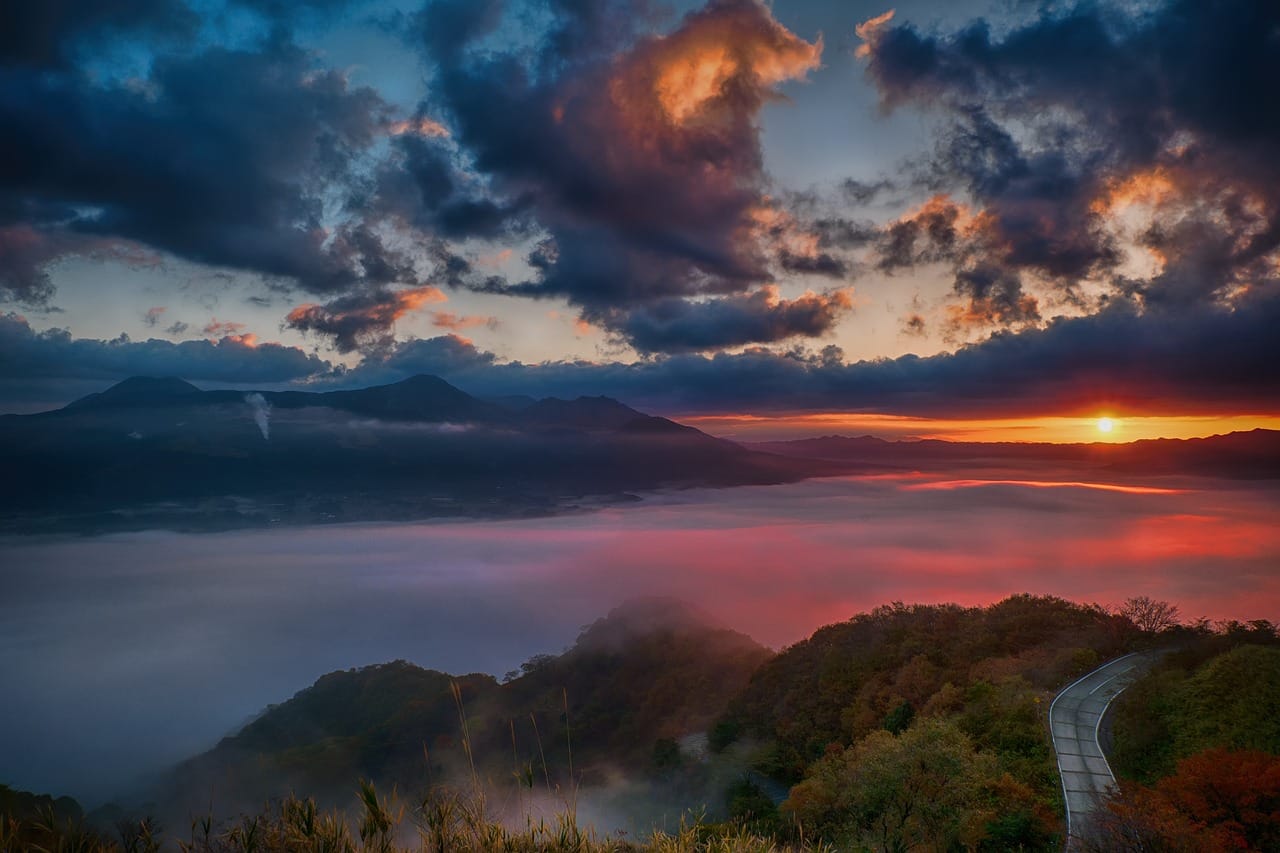
The caldera's scale is best understood from above — specifically from the Daikanbo viewpoint (大観峰) on the caldera's northern rim, from which the full caldera basin is visible: the cluster of five peaks in the center, the vast grasslands of the Aso plain filling the caldera floor, the ring of forested outer rim mountains, and the towns of Aso City visible in the caldera's eastern section.
From this viewpoint, the caldera's history becomes spatially comprehensible: what you are looking at is the collapsed interior of a volcano that was, before its eruptions, approximately as large as Mount Fuji. The scale of the geological event that created this basin — and the fact that people have farmed and lived within it since the earliest human settlement of Kyushu — establishes the particular character of Aso: a landscape simultaneously of sublime geological violence and of ordinary, enduring human life.
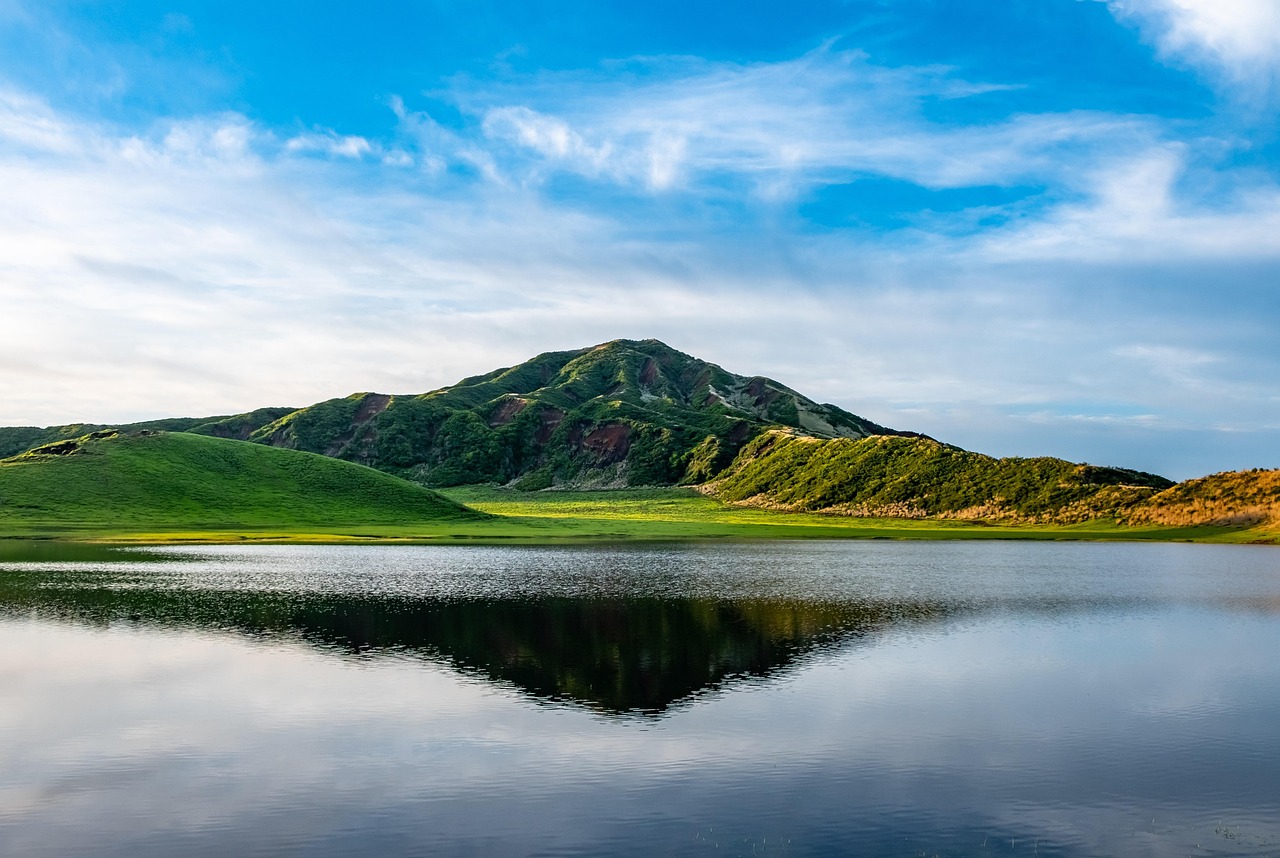
Aso Caldera Grasslands (草千里ヶ浜 / Kusasenri-ga-hama): The ancient volcanic landscape around Nakadake includes Kusasenri — a flat grassy plain with two circular ponds, surrounded by the volcanic peaks. Wild horses graze here (maintained for the traditional caldera horsemanship culture), and the landscape — green grass, volcanic skyline, horses — has a quality that recalls Iceland or Iceland's analog in Japanese geography.
Nakadake Crater: The Active Vent
The Nakadake crater (中岳火口) is the primary destination. When open to visitors, it is reached from the Asosan-Nishi (阿蘇山西) area either by the loop shuttle bus (the old ropeway was dismantled after eruption and earthquake damage; the shuttle costs around ¥1,000 round trip) or by a walking trail of roughly 30–40 minutes.
The Crater Experience
The crater is approximately 600 meters in diameter and up to 130 meters deep. Its character changes constantly — during quiescent periods, a turquoise-colored crater lake (火口湖 / kōkōko) fills the bottom, the sulfuric gases dissolving in the water to create the characteristic color. During more active periods, the lake drains or evaporates and the dry active vent becomes visible — a grey-black zone from which steam and gas emerge continuously.
Standing at the crater rim, the physical experience is multi-sensory: the smell of sulfur is strong enough to be slightly irritating (gas masks are available for rental near the crater); the heat radiating from the volcanic materials below is perceptible; the sound — a low, intermittent rumbling from within the crater — is audible on quiet days. The visual of the crater — whatever state it is currently in — is overwhelming in scale.
Concrete shelters: Along the crater rim, concrete bunkers with thick walls are available for emergency protection in case of unexpected eruption. Their presence is both reassuring and concentrating — a reminder that this is not a theme park exhibit but an active geological system.
Access Restrictions
This is the most important practical consideration for Aso: the crater is frequently closed due to eruption activity or elevated gas levels. Major eruptions in 2014 and 2016 caused significant infrastructure damage and extended closures. The 2016 Kumamoto earthquakes (magnitude 7.0, killing 50 people) caused the Aso ropeway to close for several years.
Before any Aso visit, check the current volcanic alert level with the Japan Meteorological Agency (JMA / 気象庁) — the volcanic alert level (火山警戒レベル) for Aso Nakadake is updated continuously and determines what access is permitted. At Level 1 (lowest), crater rim access is typically possible. At Level 2, the area within 1 km of the crater is restricted. At Level 3 and above, the entire mountain is closed.
Hiking the Caldera: Beyond the Crater
Nakadake to Takadake (高岳) Traverse
Takadake (1,592 meters) — Aso's highest peak — is hikeable via a trail that begins from the Nakadake crater area and traverses the ridge to the east. The round trip from the ropeway summit takes approximately 3 hours and offers the most complete view of the caldera's multiple peaks from above.
Komezuka (米塚): The Perfect Parasitic Cone
Komezuka — "Rice Mound" — is a small parasitic volcanic cone approximately 80 meters tall with a perfectly circular depression at its summit, located in the caldera's western section along the road from Aso Station to Nakadake. The cone's shape — a near-perfect hemisphere with the characteristic depression — is one of the most textbook-perfect examples of volcanic parasitic cone morphology in Japan and is instantly recognizable in photographs of the Aso caldera.
The Aso Area Beyond the Volcano
Shiratori Shrine (白鳥神社): Near Aso Station, a small shrine associated with the Japanese mythological prince Yamato Takeru (日本武尊), whose legend is connected to Mount Aso in the ancient chronicles.
Aso Shrine (阿蘇神社): The major Shinto shrine of the Aso caldera, damaged in the 2016 earthquake (the楼門 / two-story gate collapsed) but still operating and undergoing restoration. The shrine's 楼門 (Rōmon gate) when restored will be one of the finest examples of its type in Kyushu.
Recommended Base Hotels
- Sozankyo (蘇山郷) (Mid-range / from ¥18,000 per person): Historic onsen ryokan in Uchinomaki, inside the caldera.
Wellness Kyukamura Minamiaso (Mid-range / from ¥15,000 per person): Southern caldera location near Minamiaso Village.
Aso Base Backpackers (Budget / from ¥3,500): International hostel near Aso Station, excellent for solo travelers.
Planning where to stay in Kyushu & Okinawa? Browse our honest hotel picks and area guides.
🏨 Planning where to stay?
Every area guide on this site pairs with honest, station-by-station hotel picks. Start here: Kumamoto Hotel Guides →