This article may contain affiliate links. If you book through them, we may earn a small commission at no extra cost to you.
On this page
- Miyajima Island (厳島): Floating Torii Gate, Deer & the Best Momiji Manju
- The Floating Torii Gate (大鳥居): Understanding What You're Looking At
- Itsukushima Shrine (厳島神社): The Architecture Over Water
- The Deer of Miyajima
- Daisho-in (大聖院): The Mountain Temple
- Mount Misen (弥山): The Sacred Mountain
- Momijidani (紅葉谷): The Maple Valley
- Momiji Manju (もみじまんじゅう): Miyajima's Famous Confection
- Practical Notes for Visiting
- Recommended Base Hotels
Miyajima Island (厳島): Floating Torii Gate, Deer & the Best Momiji Manju
Introduction: The Island That Has Been Sacred for 1,400 Years
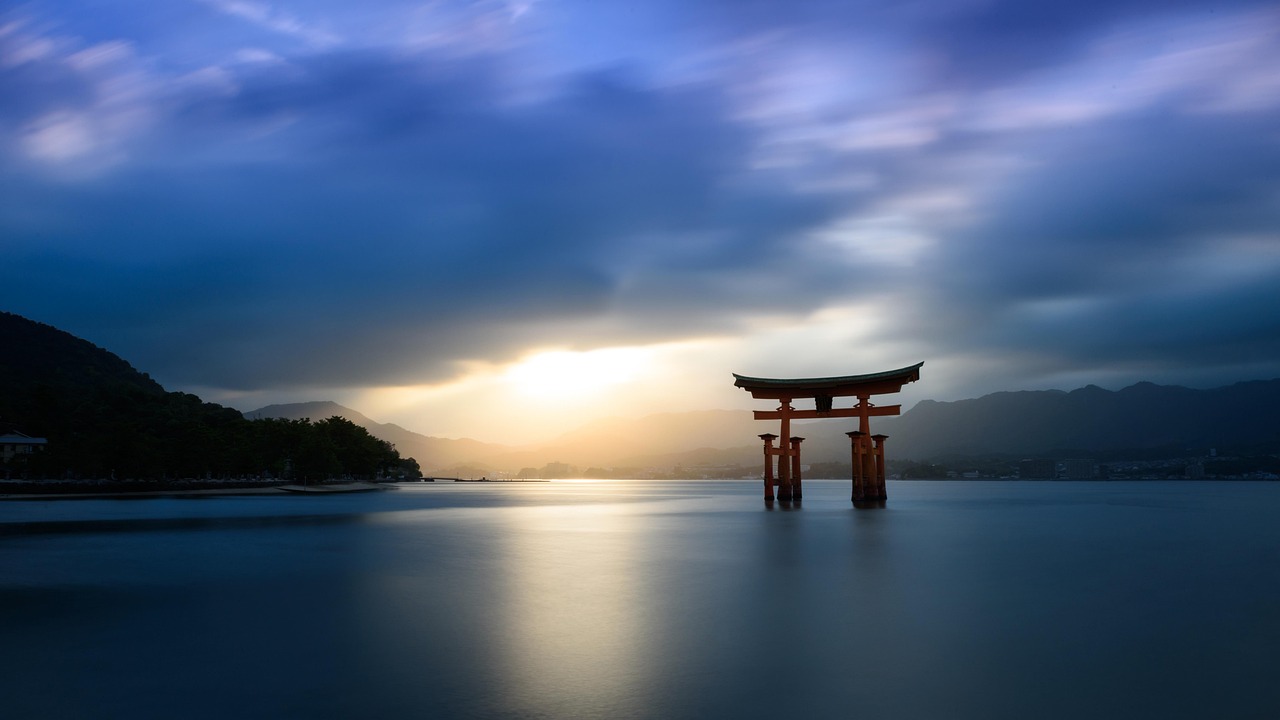
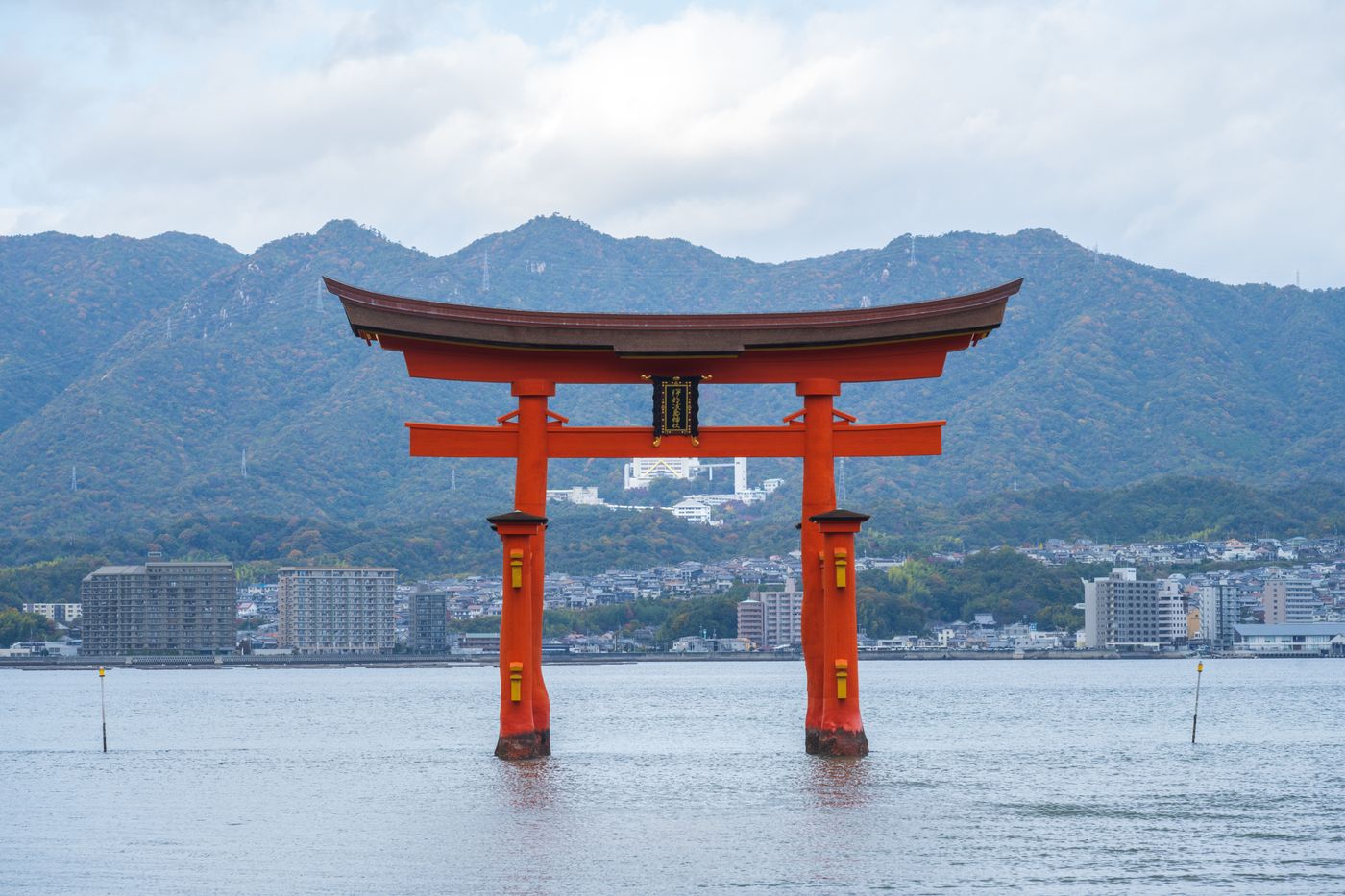
There are three views in Japan that have been celebrated as the country's most beautiful since the Edo period — the Nihon Sankei (日本三景). One is the pine-island bay of Matsushima in Miyagi. One is the sand spit of Amanohashidate in Kyoto Prefecture. The third is Miyajima (宮島) — the island in Hiroshima Bay where the Itsukushima Shrine (厳島神社) extends its vermilion buildings over the sea and the Great Torii Gate (大鳥居) stands in the tidal waters, its reflection shifting with the light and the tide through the day.
The island's formal name is Itsukushima (厳島) — "severe island" or "island of worship" — but it has been called Miyajima ("shrine island") by the people who live near it for so long that the popular name has effectively replaced the formal one. The name reflects the island's fundamental character: for most of its recorded history, Miyajima has not been a place where ordinary people lived but a place where people came to worship — an island so sacred that for centuries birth and death were prohibited on its shores, and the sick and pregnant were taken to the mainland.
The Floating Torii Gate (大鳥居): Understanding What You're Looking At
The Great Torii Gate of Itsukushima Shrine stands in the sea approximately 200 meters from the shrine's main building. At high tide, the gate appears to float — the water surrounding its base, the mountainside behind it, the shrine buildings to one side. At low tide, the seabed around the gate is exposed, and visitors can walk out across the sand and seaweed to stand at the gate's base.
Both experiences are extraordinary and completely different. The high-tide view is the famous image — the gate's reflection in the water, the visual impression of the structure floating free of the earth. The low-tide walk is the more intimate experience — standing at the base of a structure 16 meters tall, seeing the barnacles on the great wooden pillars, touching the ancient wood.
The Gate's Construction
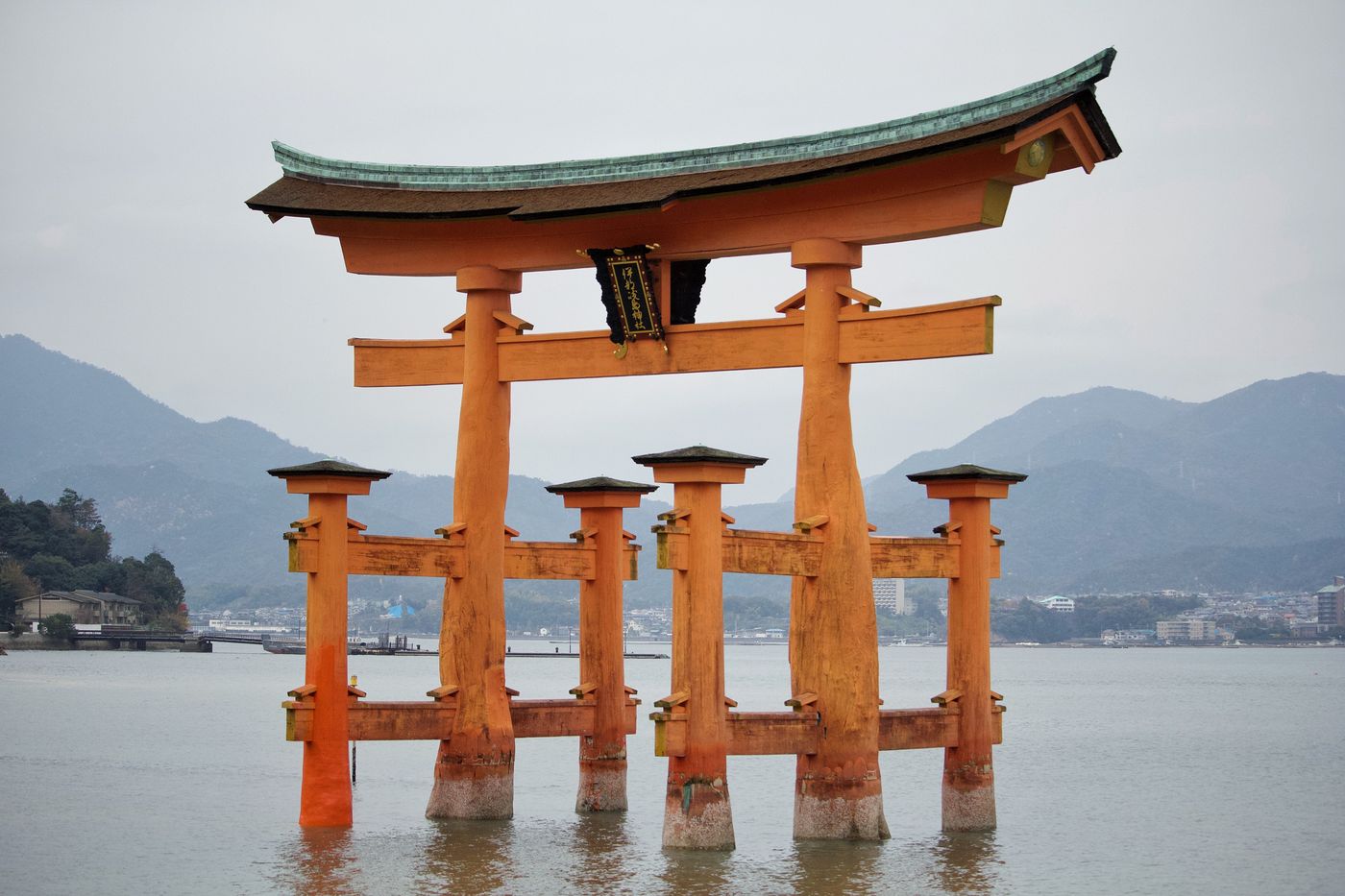
The current gate (the eighth version — the gate has been rebuilt multiple times through fire and storm damage) was erected in 1875 and is constructed from camphor wood (クスノキ), chosen for its natural resistance to saltwater and insects. The pillars are not anchored to the seafloor — the gate's weight alone (approximately 60 tons) holds it in position, a structural decision made to allow tidal movement without foundation damage.
The gate's height of 16.6 meters (to the top of the crossbeam) and span of 24 meters were designed so that large ships could pass beneath the central arch at high tide — the gate functioning as both spiritual marker and practical navigation aid for the considerable sea traffic of the historical Inland Sea.
The vermilion color: The specific red-orange of the gate and shrine buildings (a mineral pigment called tan / 丹) has practical as well as aesthetic function — the compound's properties resist saltwater corrosion and insect damage. The visual effect against the green mountain behind and the blue-grey sea below creates the color combination that defines the island's visual identity.
Itsukushima Shrine (厳島神社): The Architecture Over Water
Itsukushima Shrine is one of Japan's most unusual religious buildings — a complex of corridors, stages, and halls built on wooden piles over the tidal waters of the bay. At high tide, the shrine appears to float; at low tide, it rests on exposed seafloor mud.
The shrine was founded in 593 CE but reached its current form in the 12th century under the patronage of Taira no Kiyomori (平清盛) — the most powerful man in Japan at the time, who rebuilt the shrine as an expression of his family's wealth and divine favor. The design of extending the shrine over the water — making it inaccessible by foot even at low tide in its original configuration — served the island's sacred status by preventing ordinary people from approaching on the same level as the deities.
The shrine's main hall and the connecting covered corridors are designated National Treasures. Walking through the shrine complex at high tide — the water visible through the gaps in the corridor floorboards, the buildings rising around you while the sea moves below — is one of the most architecturally distinctive experiences in Japan.
Noh Stage (能舞台): The shrine's Noh stage — extending directly over the water — is used for Noh performances during the Kangensai Festival (管絃祭) in July, when court music is played from boats on the water. The image of Noh performance over the Seto Inland Sea at night is one of Japan's most celebrated cultural tableaux.
The Deer of Miyajima
Like Nara, Miyajima has free-roaming deer — approximately 500 sika deer that have been present on the island since antiquity, also considered sacred messengers of the deities. Unlike Nara's deer (which are fed deer crackers and are somewhat managed), Miyajima's deer are wilder and less habituated to feeding — which makes them simultaneously more atmospheric and more unpredictable.
The important difference from Nara: Miyajima's deer cannot be legally fed. The island authorities have implemented a strict no-feeding policy because the deer had developed nutritional deficiencies from eating tourist food and had become aggressive in seeking it. The deer now eat natural vegetation — and while they roam freely through the island's streets and temple precincts, the relationship between visitors and deer is one of observation rather than interaction.
The deer's presence throughout the island — lying in the shade of temple buildings, walking across the shrine's approach path, grazing on the mountain slopes — contributes significantly to the island's atmosphere of ancient sanctity.
Daisho-in (大聖院): The Mountain Temple
A 15-minute walk from the ferry terminal, Daisho-in is the most significant Buddhist temple on Miyajima — a complex of buildings climbing the lower slopes of Mount Misen (弥山) with an extraordinary collection of stone lanterns, spinning prayer wheels, sand mandalas, and Buddhist iconography that creates a visual density unlike the shrine's Shinto simplicity.
The temple's Maniden Hall contains a fire that is said to have been burning continuously since Kōbō Daishi lit it over 1,200 years ago — making it one of Japan's sacred "eternal fires" alongside the flame at Kōya-san.
Mount Misen (弥山): The Sacred Mountain
Mount Misen (弥山 / 535 meters) is the island's sacred mountain — the place where Kōbō Daishi (Kūkai) practiced for 100 days in the 9th century, and where several of the island's most important sacred sites are located.
Access: Ropeway from Momijidani Station to Shishiiwa Station (approximately 15 minutes), then a 30-minute trail to the summit. Alternatively, several hiking trails from the base of the mountain provide routes of 1.5–2.5 hours.
The summit view: From the summit of Misen, the full panorama of the Seto Inland Sea spreads in every direction — the scattered islands of the sea, the bridges of the Shimanami Kaidō to the east, the coastline of Hiroshima Bay to the north, and the open Pacific glinting in the southern distance. This is one of Japan's most rewarding summit views, combining natural grandeur with the knowledge of the mountain's spiritual history.
Momijidani (紅葉谷): The Maple Valley
Momijidani Park (紅葉谷公園) — the forested valley below the ropeway station — contains hundreds of maple trees that turn brilliant red and orange in November, creating one of the finest concentrated autumn foliage displays in the Hiroshima area. The combination of the maple-covered valley, the mountain rising above, and the traditional stone path through the park makes Momijidani one of the most atmospheric autumn walking destinations in western Japan.
Momiji Manju (もみじまんじゅう): Miyajima's Famous Confection
Momiji manju — maple-leaf-shaped sponge cakes filled with red bean paste, custard, chocolate, or other fillings — are Miyajima's definitive food souvenir. First made in the early 20th century, the cakes have been adopted as the island's edible symbol to the point where virtually every shop on the main street sells some version of them.
Quality varies significantly. The best momiji manju are made with high-quality sweet bean paste (tsubuan / 粒あん — the chunky version, which most specialists prefer — or koshian / こしあん, the smooth version) in a freshly baked shell rather than mass-produced in batches. Several shops on the main street bake them continuously and sell them warm — the warm-from-the-oven version is substantially better than the packaged version available as airport gifts.
Recommended shops:
Yamada-ya (やまだ屋): The most famous Momiji manju producer, with multiple island locations. Their nama momiji (生もみじ) — a softer, more mochi-like version using warabi starch in the shell — has attracted significant attention as a premium variant.
- Kisshoen (吉老恵): Smaller production, higher quality bean paste sourced from Hokkaido adzuki beans.
Fried momiji manju (揚げもみじ): A relatively recent innovation — momiji manju deep-fried in light batter until crispy outside, still soft inside. Available as street food throughout the main street and genuinely excellent despite sounding improbable.
Practical Notes for Visiting
Crowds: Miyajima is one of Japan's most visited sites, and the main street, shrine approach, and torii gate area are extremely crowded from 10:00 AM to 4:00 PM. The ferry's first crossing (approximately 6:30 AM) delivers visitors to an almost-empty island — the morning light on the torii gate at dawn is exceptional, and the shrine precincts are accessible with few other visitors.
Staying overnight: The island has several ryokan and hotels. Staying overnight allows the full experience of the island after the day visitors leave — the evening atmosphere at the shrine, lit by lanterns, with the deer moving through the empty paths, is categorically different from the daytime experience.
High and low tide: The JR ferry terminal posts daily tide tables. Planning to arrive at high tide for the floating gate view and return (or stay) to walk to the gate at low tide gives both experiences in one visit.
Recommended Base Hotels
On the Island
- Miyajima Grand Hotel Arimoto (Luxury / from ¥40,000 per person): Waterfront ryokan with shrine view rooms.
Kinsuikan (錦水館) (Mid-range–Upper / from ¥22,000 per person): Long-established waterfront ryokan on the shrine approach.
Hiroshima (for day trip)
- The Knot Hiroshima (Mid-range / from ¥12,000): Central Hiroshima, convenient streetcar access to the ferry.
Planning where to stay in Chugoku? Browse our honest hotel picks and area guides.
🏨 Planning where to stay?
Every area guide on this site pairs with honest, station-by-station hotel picks. Start here: Hiroshima Hotel Guides →