This article may contain affiliate links. If you book through them, we may earn a small commission at no extra cost to you.
On this page
- Introduction: The Valley at the End of the World
- The Legend: Why Iya Is Remote
- Kazurabashi (かずら橋): The Vine Bridges
- The Architecture: Thatched Farmhouses on the Mountain
- The Mountain Landscape: Iya's Defining Character
- Autumn in Iya: One of Japan's Finest Foliage Landscapes
- Practical Notes
- Recommended Base Hotels
Introduction: The Valley at the End of the World
There are places in Japan that feel genuinely remote — not in the sense of being difficult to reach from Tokyo, but remote in the older sense: places where the surrounding landscape is so dominant, so indifferent to human scale, that the ordinary certainties of daily life feel temporarily suspended.
The Iya Valley (祖谷渓 / Iya-kei) in western Tokushima Prefecture is one of those places. A river valley carved deep into the Shikoku mountain range, surrounded by ridges rising to over 1,900 meters on all sides, accessible historically only by paths that were deliberately difficult — Iya has maintained a quality of geographic isolation that has shaped its culture, its architecture, and its psychology in ways that are immediately apparent to any visitor.
The valley is famous for two things internationally: its vine bridges (かずら橋 / kazurabashi) — three suspension bridges woven from the vines of shirakuchi-kazura (しらくちかずら — a wild mountain kiwi vine, Actinidia arguta), rebuilt every three years in a tradition going back centuries — and the thatched farmhouses (茅葺き民家) scattered across the mountain slopes, some over 300 years old, that represent the most complete surviving example of traditional mountain farming architecture in Japan.
The Legend: Why Iya Is Remote
The valley's extreme inaccessibility was not accidental — it was cultivated. According to historical tradition, Iya was settled by the Heike clan (平家) — the losing side of the Genpei War (源平合戦 / 1180–1185) — who fled into the Shikoku mountains after their defeat at the Battle of Dan-no-Ura and chose the most inaccessible valley they could find to avoid discovery by the victorious Minamoto forces.
The Heike legend permeates the valley's cultural identity: villages trace their ancestry to the fleeing warriors, the distinctive architecture and customs are attributed to the aristocratic origins of the settlers, and the vine bridges are said to have been built so that they could be cut in case of pursuit — a theory about their deliberate fragility that explains the annual reconstruction.
This legend cannot be fully historically verified, but its cultural reality — the way it shapes how the valley understands itself — is entirely genuine.
Kazurabashi (かずら橋): The Vine Bridges
The Kazurabashi are the most immediately dramatic element of the Iya Valley experience — suspension bridges woven from the vines of shirakuchi-kazura (しらくちかずら — a wild mountain kiwi vine, Actinidia arguta), a climbing plant native to the Shikoku mountains. The bridges are rebuilt every three years from fresh vines in a ceremony that maintains the traditional technique.
There are three vine bridges in the Iya Valley:
Iya Kazurabashi (祖谷かずら橋): The most accessible and most visited — a 45-meter span across the Iya River, suspended approximately 14 meters above the water. The bridge sways with each step, and the gaps between the vine-woven walkway are large enough to see the river clearly below. The crossing takes approximately 5 minutes, the experience considerably longer in memory. Entry: ¥550.
Oku-Iya Niju Kazurabashi (奥祖谷二重かずら橋): Two bridges side-by-side in the deeper valley — a "husband and wife bridge" said to have been used for courtship in the historical community. The more remote location means significantly fewer visitors, and the mountain valley setting is more dramatically scenic.
The vine bridge technique: The vine construction — cross-wound vines creating a walkway surface with vine handrails — creates a structure that is genuinely less stable than a metal or wooden bridge. The flex and sway of the bridge with each step is not a performance; it is the actual behavior of a vine structure under human weight. The experience is exciting in a way that is specific to the material.
The Architecture: Thatched Farmhouses on the Mountain
The thatched farmhouses (茅葺き民家 / kayabuki minka) scattered across the Iya Valley's mountain slopes are among the most architecturally significant rural structures in Japan — and among the most threatened. The combination of depopulation (the valley's population has declined from over 10,000 in the 1960s to approximately 1,800 today), the aging of the remaining population, the difficulty and expense of thatch maintenance, and the lack of young craftspeople trained in traditional techniques means that these buildings are disappearing.
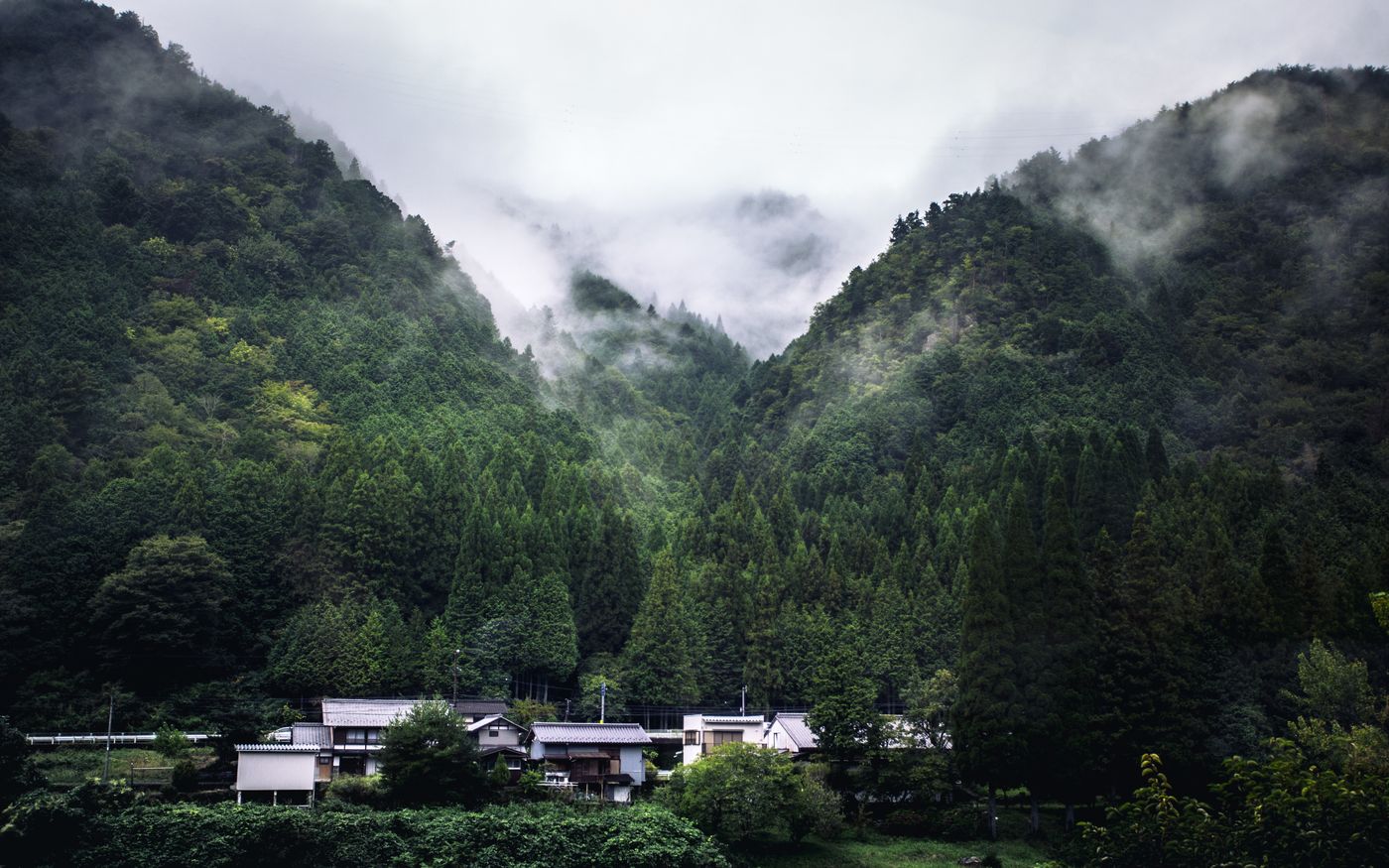
Several organizations — most notably the American-Japanese conservationist Alex Kerr (アレックス・カー), who has been working in Iya since the 1970s and has written extensively about the valley in his book "Lost Japan" (美しき日本の残像) — have worked to preserve and repurpose the farmhouses as accommodation.
Chiiori (ちいおり): The most famous of the preserved farmhouses — a 300-year-old thatched house restored by Alex Kerr and now available for rent as a holiday accommodation. Staying in Chiiori — sleeping on tatami below a vast thatched ceiling, looking out over the mountain valley, with no nearby neighbors — is one of the most immersive traditional Japan experiences available anywhere.
The Mountain Landscape: Iya's Defining Character
The valley's visual character is defined by extreme topography: the Iya River (祖谷川) runs through a gorge approximately 200 meters below the surrounding ridges, and the farmhouses and roads are built on slopes of 30–45 degrees that require terracing for any cultivation. The result is a landscape of extraordinary vertical drama.
Iya-kei Gorge (祖谷渓): The gorge section of the river below the main Kazurabashi is accessible by a switchback road that descends to the river level, with several viewpoints looking down into the gorge from above. The famous Koboke and Oboke (小歩危・大歩危) gorge sections — rapids and rock formations where the river cuts through ancient metamorphic rock — are accessible by sightseeing boat from the valley's entrance near Awa-Ikeda.
Biwa-no-Taki (琵琶の滝): A 50-meter waterfall near the Kazurabashi, said to have been played beside by Heike refugees who consoled themselves with music in the remote valley. The waterfall and the surrounding cedar forest create an atmosphere of enclosed green tranquility.
Peeing Boy Statue (小便小僧): Perched on a precarious rock outcropping above a 200-meter drop into the Iya gorge, a small statue of a peeing boy has been here since 1968 — a local tradition involving visitors daring each other to stand at the cliff edge. The view from this point (accessible if you choose) is one of the most vertiginous in Japan.
Autumn in Iya: One of Japan's Finest Foliage Landscapes
The Iya Valley in October and November transforms into what many specialist foliage viewers consider the finest sustained autumn color landscape in Japan. The combination of the valley's extreme depth and the surrounding ridges creates a contained landscape where the full range of deciduous foliage — maple, oak, beech, hornbeam — turns simultaneously, the color visible from the valley floor all the way to the ridge lines 1,000 meters above.
The specific quality of light in deep mountain valleys during autumn — the late afternoon sun reaching only the highest ridges while the valley floor is in shadow, the ridge lines burning orange and red against a pale blue sky — produces color photographs of exceptional quality without any technical manipulation.
Practical Notes
Getting around: The valley has extremely limited public transport. A car is effectively essential for visiting Oku-Iya and the more remote farmhouses. Rental cars are available in Tokushima, Kochi, and Matsuyama.
Accommodation: Iya has limited but excellent accommodation — the farmhouse inns and ryokan that do operate are among the most atmospheric in Shikoku. Advance reservation is essential and often required weeks in advance during autumn.
Season: Spring (May, when the new foliage is vivid green against the old thatch) and autumn (October–November) are the peak seasons. The valley in winter — snow on the mountain ridges, the farmhouses half-buried in white — is extraordinary but requires careful planning for road access.
Recommended Base Hotels
Chiiori Trust Farmhouse (Unique / from ¥15,000 per night for the whole house): The Alex Kerr–restored 300-year-old farmhouse — the most atmospheric accommodation in the valley and possibly in Japan.
Iya Onsen Hotel (祖谷温泉) (Luxury / from ¥35,000 per person): The valley's hot spring hotel, accessible by private cable car descending the gorge cliff — one of Japan's most dramatic hotel access experiences.
Kazurabashi Lodge (Mid-range / from ¥15,000 per person): Near the main vine bridge, convenient for early morning visits before the day-trip crowds arrive.
Planning where to stay in Shikoku? Browse our honest hotel picks and area guides.
🏨 Planning where to stay?
Every area guide on this site pairs with honest, station-by-station hotel picks. Start here: Tokushima Hotel Guides →