This article may contain affiliate links. If you book through them, we may earn a small commission at no extra cost to you.
On this page
Introduction: The Bridge, the Fish, and the Forgotten Island
Ask any Osaka local where they go on a day off and the answers converge on a few places that international tourism has largely missed. Akashi (明石) and Awaji Island (淡路島) are consistently among them — a combination of a historic fishing city famous for the finest sea bream in Japan and an island of farms, flowers, and extraordinary sea views connected to the mainland by the world's longest suspension bridge.
Akashi (明石): The Meridian City and Japan's Finest Sea Bream
Akashi has two claims to distinction that are entirely unlike each other: it is the city through which Japan's standard time meridian passes (135°E — making it Japan's official time reference since 1886), and it produces what is widely considered Japan's finest sea bream (鯛 / tai).
Akashi Ichiba (明石市場): The Fish Market
Akashi Uonotana (魚の棚商店街) — "Fish Shelf Market" — is a 350-meter covered shopping street near Akashi Station that has been the retail center of Akashi's fishing culture for 400 years. The market's 110 shops sell fresh fish, processed seafood, and Akashi's specialty products — and the atmosphere of an active working fish market (rather than a tourist attraction) gives the street a vitality that more famous markets sometimes lack.
Akashi sea bream (明石鯛): The sea bream from Akashi's tidal waters — caught in the strong currents of the Akashi Strait below the suspension bridge — is considered the finest in Japan due to the exercise the fish get in the strong currents, which develops a firmer texture and more pronounced flavor. Tai no Karaage (鯛のから揚げ), Tai Chazuke (鯛茶漬け), and Tai Sushi (鯛寿司) are the local preparation styles available throughout the market.
Akashiyaki (明石焼き)
Akashiyaki — the original from which Osaka's takoyaki developed — is a softer, egg-heavier version of the octopus dumpling, served in a broth (dashi) rather than with sauce. The experience of dipping the soft, quivering ball into hot dashi and eating it with the broth as a primary flavoring element is completely different from the takoyaki experience, and specialists consider Akashiyaki the more refined of the two.
Akashi Castle (明石城)
A small but well-preserved castle ruin from the early 17th century, with two surviving turrets (Higashi-Turret and Nishi-Turret) providing views over the Akashi Strait. The castle grounds (free entry to the park) are excellent in cherry blossom season.
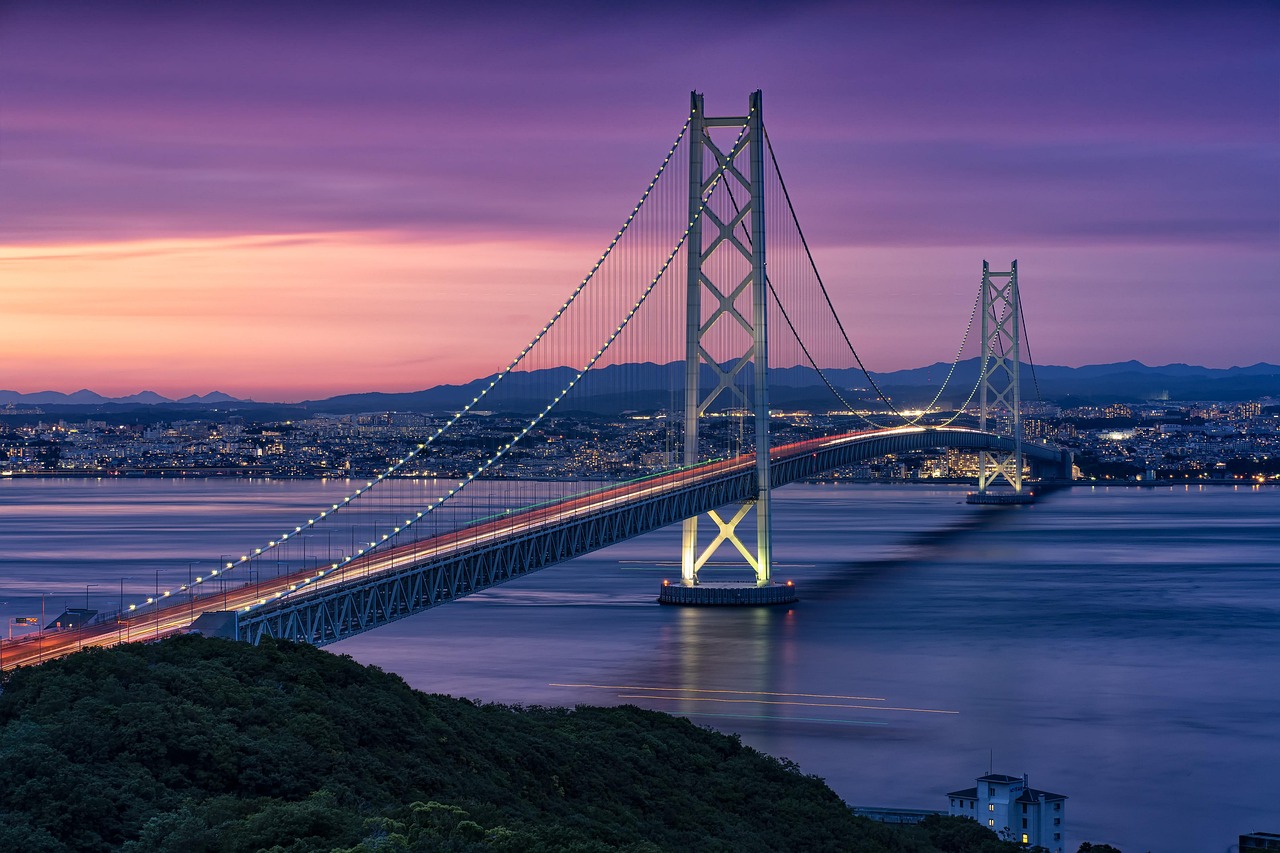
Akashi Kaikyo Bridge (明石海峡大橋): The World's Longest Suspension Bridge
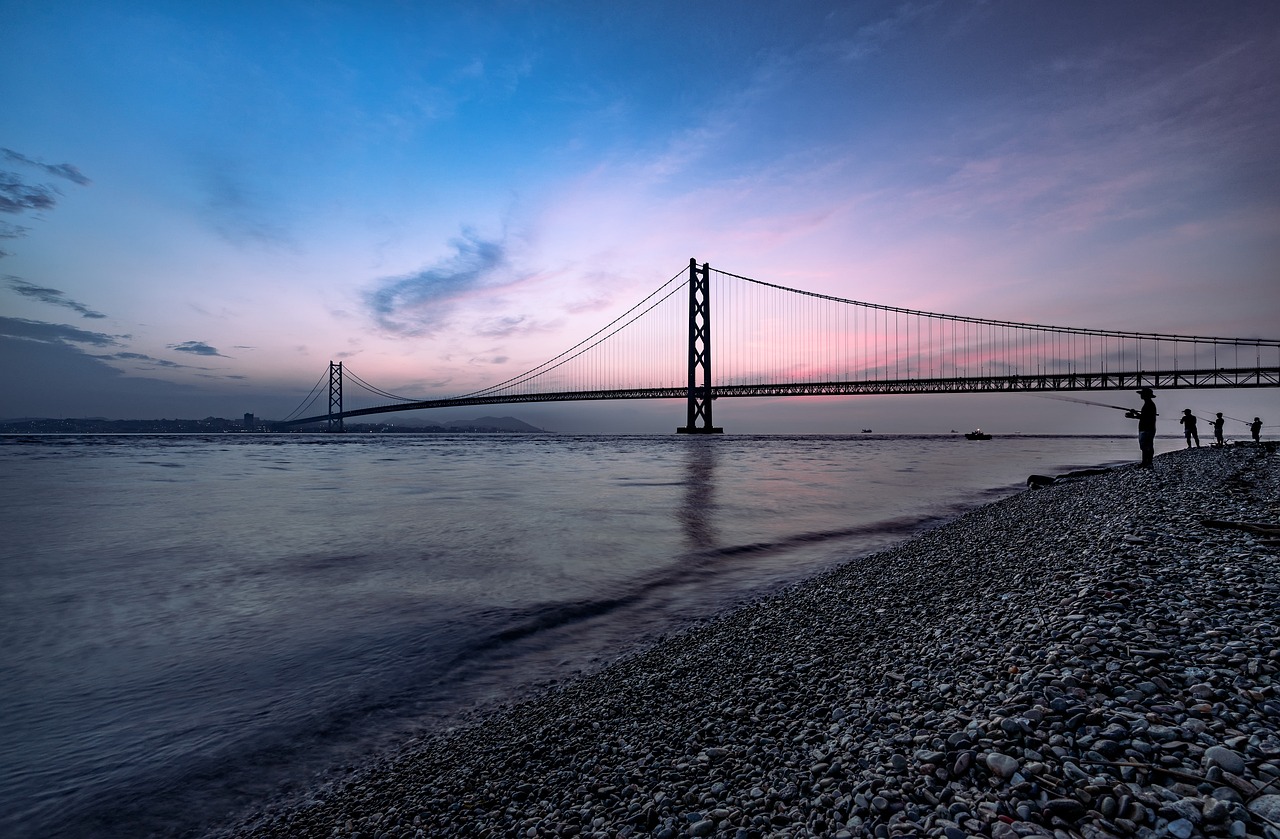
The Akashi Kaikyo Bridge — completed in 1998 and connecting the Akashi side of the mainland with Awaji Island — is the world's longest suspension bridge at 3,911 meters. The central span alone (1,991 meters) exceeds any other suspension bridge span in the world.
Maiko Marine Promenade (舞子海上プロムナード): At the Kobe end of the bridge, a visitor facility provides access to a glass-floored walkway extending over the water from the bridge's main tower. The view from this walkway — the bridge's cables extending into the distance, the Akashi Strait below through the glass floor — is one of the most vertiginous views available from a fixed structure in Japan. Entry: ¥310 (approx. $2.1).
Awaji Island (淡路島): The Garden Island
Awaji Island — the largest island in the Seto Inland Sea — has a character entirely unlike the urban Kansai that surrounds it: agriculture, flower farms, clean air, quiet roads, and the sea visible from almost everywhere on the island. The Awajishima onion (淡路玉ねぎ) is considered Japan's finest, the island's fresh seafood is exceptional, and the driving or cycling circuits of the island (150 km circumference) offer sustained coastal and mountain scenery of considerable beauty.
Awaji Hanasajiki (あわじ花さじき): The Flower Fields
On the northern slopes of Awaji Island, Hanasajiki is a series of hillside flower fields that bloom in sequence from spring through autumn — tulips in April, poppies in May, sunflowers in August, cosmos in October. The view from the hillside across the flower fields to the Akashi Strait and the mainland beyond is extraordinary on clear days.
Izanagi Jingu (伊弉諾神宮)
Izanagi Jingu is one of Japan's oldest and most significant Shinto shrines — enshrining the creator deities Izanagi and Izanami, who in Japanese mythology created the islands of Japan. The island of Awaji is considered in the creation myth to be the first land created — giving this shrine a cosmological significance within Shinto theology that makes it one of Japan's most important.
Recommended Base Hotels
Grand Nikko Awaji (Luxury / from ¥35,000 (approx. $235)): The hotel at Tadao Ando's Yumebutai complex on Awaji's northern coast — one of Japan's finest architectural hospitality spaces.
- Green Hill Hotel Akashi (Mid-range / from ¥12,000 (approx. $80)): Akashi Station area, convenient for market and castle.
Planning where to stay in Kansai? Browse our honest hotel picks and area guides.
🏨 Planning where to stay?
Every area guide on this site pairs with honest, station-by-station hotel picks. Start here: Hotel Guides by Station →