This article may contain affiliate links. If you book through them, we may earn a small commission at no extra cost to you.
On this page
Introduction: The Road That Takes You Above the Clouds
The Tateyama Kurobe Alpine Route (立山黒部アルペンルート) is one of Japan's most extraordinary transportation experiences — a 37 km mountain crossing through the Northern Japan Alps that uses six different transport modes — cable cars, highland bus, ropeway, and the electric tunnel buses that until December 2024 were Japan’s very last trolleybuses to traverse terrain between the two prefectures of Toyama and Nagano that would otherwise require a 5-hour road circuit.
The route crosses the Tateyama mountain range (立山連峰) at a maximum elevation of approximately 2,450 meters, passing through alpine landscapes of extraordinary scale and, in the spring season (mid-April to mid-June), through the phenomenon that has made the route internationally famous: the Yuki no Otani (雪の大谷 / Snow Corridor) — a road corridor cut through accumulated winter snow to depths that sometimes exceed 20 meters.
Standing at the base of a 20-meter snow wall, the road cutting through it like a slot, the snow surface extending upward to a thin blue line of sky above — this is one of Japan's most dramatic seasonal spectacles and one of the world's few places where the accumulated snowpack of an alpine winter is directly accessible to ordinary visitors.
The Six Transport Modes: A Journey in Segments
1. Tateyama Cable Car (立山ケーブルカー)
Tateyama Station → Bijodaira Station (美女平): 7 minutes, ascending 500 meters through a heavily forested mountain slope. This is the first transition from the city (Tateyama town, at 475m elevation) into the mountain world above.
2. Tateyama Highland Bus (立山高原バス)
Bijodaira → Murodo (室堂): 50 minutes on a mountain road through successively changing vegetation zones — the forest thinning to subalpine scrub, then to open alpine terrain, then to the snow-covered landscape of the Murodo plateau. The bus windows provide the best continuous views of the changing landscape.
In spring: This section of the route is where the snowwall begins to appear alongside the road — initially a meter or two, then progressively taller as the bus ascends through the accumulated winter snowpack.
3. Murodo Plateau (室堂 / 2,450m): The Mountain Hub
Murodo is the highest accessible point of the route and the central hub of the alpine experience. The plateau is a high-altitude landscape of snow, rock, volcanic pools (the Mikurigaike pond / みくりが池, a crater lake beside which stands Japan’s highest hot-spring inn), and the Tateyama mountains (Oyama, Jodo-san, Bessan) rising above.
The Yuki no Otani: Adjacent to the Murodo bus terminal, the Snow Corridor (雪の大谷 / Yuki no Otani) is the seasonal road cut through accumulated snow. In mid-April at the corridor's opening, the snowwall on either side of the road reaches its maximum height — sometimes exceeding 20 meters. The scale is genuinely disorienting: ordinary vehicles pass through the corridor with the snow walls towering above them, the sky visible only as a narrow strip directly overhead.
Walking the corridor: Visitors can walk a designated section of the snow corridor during the Yuki no Otani Walk event period — standing at the base of the walls and looking up gives the most complete sense of the scale.
4. Tateyama Tunnel Trolley Bus (立山トンネルトロリーバス)
Murodo → Daikanbo (大観峰): 10 minutes through a tunnel bored directly through the mountain — the only section of the route in complete darkness, emerging at the Daikanbo viewpoint on the opposite face.
5. Tateyama Ropeway (立山ロープウェイ)
Daikanbo → Kurobedaira (黒部平): 7 minutes, descending the dramatic eastern face of the Tateyama range. The aerial tramway passes directly over the rugged mountain terrain — no intermediate support towers (a single span of nearly 2 km) — providing the most vertigo-inducing and most scenic of all the route's segments. The view of the Kurobe Valley (黒部峡谷) below and the Ushiro Tateyama range ahead is the most complete mountain panorama of the route.
6. Kurobe Lake and Trolley Bus
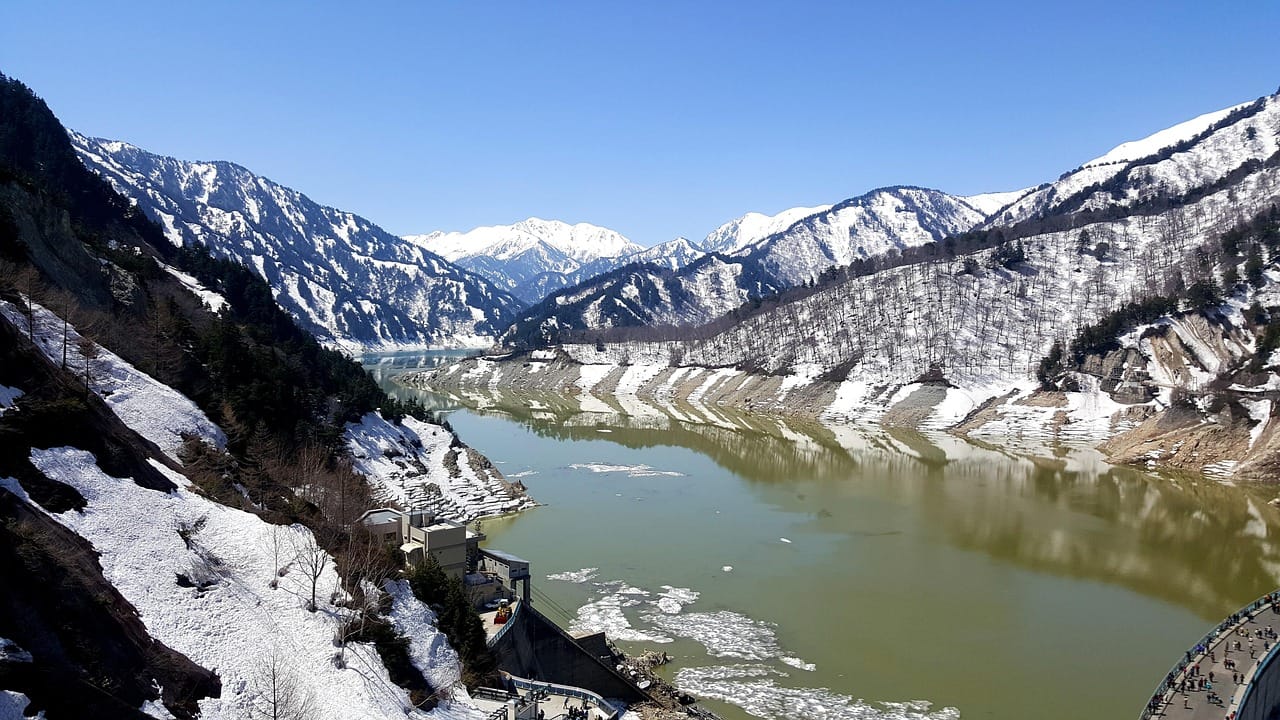
Kurobedaira → Kurobe Dam → Ogizawa: The final segments descend to the Kurobe Dam (黒部ダム) — Japan's highest dam (186 meters), completed in 1963 after seven years of construction through the most difficult terrain in Japan at a cost that included 171 workers' lives. The dam and the reservoir behind it represent a significant chapter in Japan's postwar economic development history, and the scale of the structure — with the Tateyama range rising behind it — is genuinely impressive.
Practical Planning
Weather: The alpine route is subject to rapid weather changes. Cloud and fog frequently obscure the views from Murodo and the ropeway. Checking weather forecasts before departure is essential.
Timing: The Snow Corridor is at maximum height in mid-April to early May. By mid-June, the snow has melted enough that the corridor walls are substantially reduced. For the maximum snowwall experience, April is optimal.
Booking: Ropeway segments can become fully booked during Golden Week (late April to early May). Advance booking through the official Tateyama Kurobe Alpine Route website (English available) is recommended for this period.
Recommended Base Hotels
Toyama Side
ANA Crowne Plaza Toyama (Mid-range / from ¥15,000): Toyama city center, access to Tateyama cable car via Tateyama Line.
Nagano Side
Omachi Onsen (Budget / from ¥10,000 per person): Hot spring accommodation on the Nagano side, ideal for recovering after the crossing.
Planning where to stay in Chubu? Browse our honest hotel picks and area guides.
🏨 Planning where to stay?
Every area guide on this site pairs with honest, station-by-station hotel picks. Start here: Toyama Hotel Guides →