This article may contain affiliate links. If you book through them, we may earn a small commission at no extra cost to you.
On this page
Introduction: The Island That Contains a Complete Industrial History
Hashima Island (端島) — universally known as Gunkanjima (軍艦島 / "Battleship Island") for its profile when approached by boat, which resembles a Japanese battleship — is a 6.3-hectare concrete island approximately 15 km off the Nagasaki coast that was, for most of the 20th century, one of the most densely inhabited places on earth.
At its peak in 1959, Hashima's population reached 5,259 people — approximately 835 people per hectare, a residential density exceeding that of any other human settlement in recorded history. Every person on the island lived in service of a single purpose: extracting the high-quality undersea coal seam discovered beneath the island's seafloor in 1810 and actively mined from 1887 until the island's sudden abandonment in 1974.
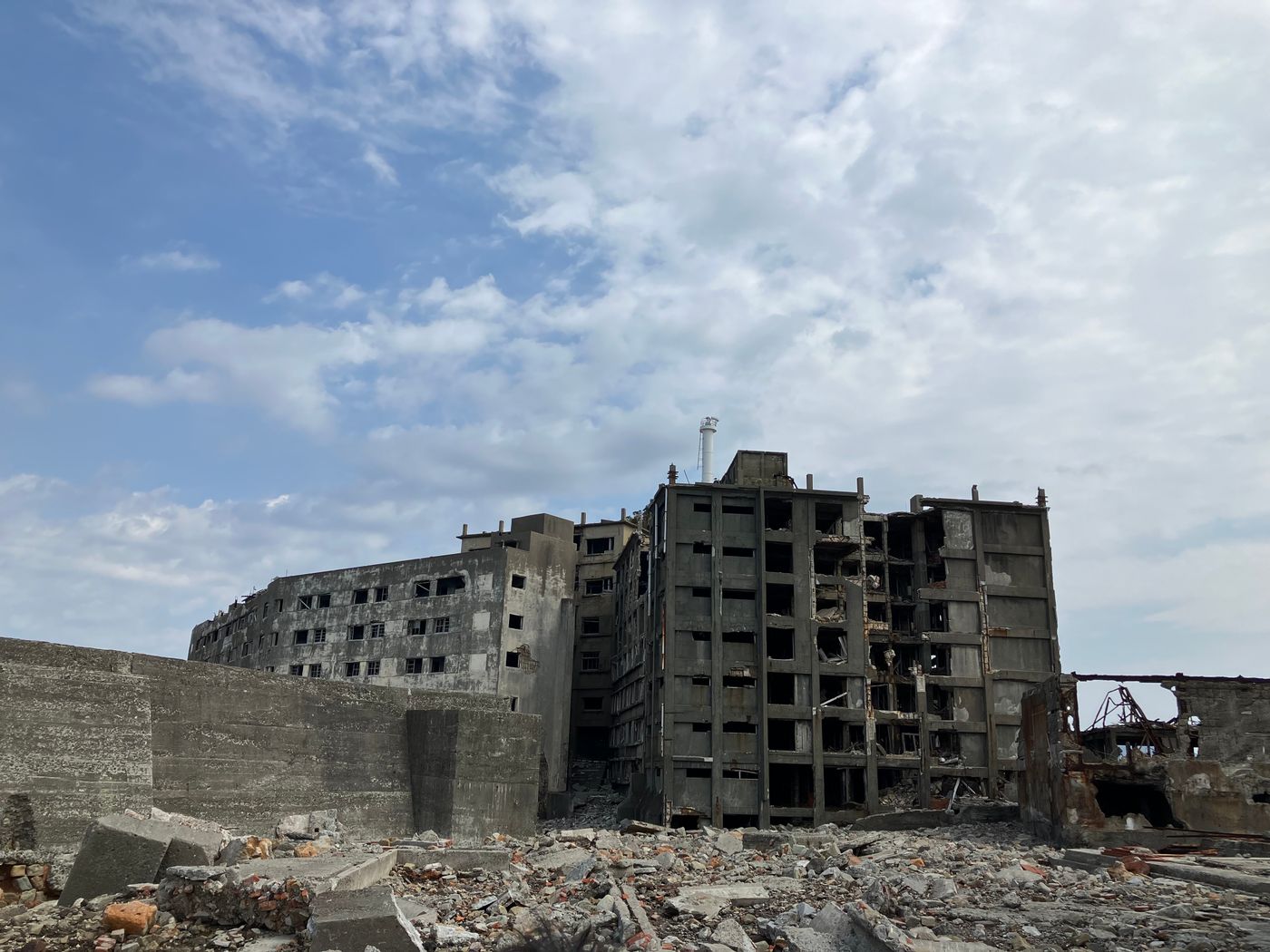
When Mitsubishi abandoned the island — a corporation decision made in three months when the economics of coal collapsed against the competing petrochemical industry — the island was left with its apartments, school, hospital, cinema, pachinkō parlors, bars, temples, and industrial infrastructure entirely intact. 50 years of salt air, typhoon wind, and structural deterioration have transformed it into something genuinely extraordinary: the most complete surviving record of 20th-century Japanese industrial residential life, preserved by abandonment rather than by intention.
The Island's History
The Coal Discovery and Industrial Development
Undersea coal deposits below Hashima were identified in 1810 and acquired by the Mitsubishi Corporation in 1890 — the beginning of a 84-year corporate ownership that would transform a small natural rock into one of Japan's most productive and most unusual industrial communities.
The challenge of mining from a small island in the East China Sea required building everything from scratch: not merely the mine shafts (extending to 1,000 meters below the seafloor) but the entire infrastructure of human life to house and sustain the mining workforce. Beginning in 1916, Hashima was progressively covered with reinforced concrete buildings — among Japan's first — stacked to maximum height on an island with no room to expand laterally.
Reinforce concrete apartment blocks (鉄筋コンクリート建築): The island's building stock represents an important chapter in Japanese architectural and industrial history — buildings whose design was determined entirely by the constraint of maximal human density on minimal land area.
Life on the Island
For several generations, the island's residents lived lives of remarkable completeness within their 6.3 hectares:
Self-contained urban infrastructure: The island had its own school (elementary through junior high), hospital, cinema, rooftop gardens where residents grew small amounts of produce, a Buddhist temple, a Shinto shrine, pachinkō halls, bars, and the full commercial and social apparatus of a small city.
The mine's vertical integration: Workers descended in elevator cages to mine shafts extending deep below the seafloor, worked 8-hour shifts in heat and constricted spaces, and returned to surface — a daily rhythm that structured the entire island's social calendar.
The community character: Residents interviewed decades after the island's closure consistently describe a specific sense of community intensity — the physical constraints of island life (no possibility of simply walking away from neighbors, no space for privacy beyond individual apartments) created social bonds of unusual closeness alongside the conflicts that proximity generates.
The Forced Labor Issue and UNESCO Controversy
The UNESCO designation of Hashima as part of the "Sites of Japan's Meiji Industrial Revolution" generated significant international controversy, specifically from South Korea, whose diplomats noted that the inscription did not acknowledge the forced labor of Korean and Chinese workers at Hashima during the World War II period.
Historical records document that approximately 800 Korean and Chinese laborers were brought to Hashima under the wartime mobilization program (1943–1945), working under conditions that survivor testimonies describe as involving physical abuse, inadequate food, and difficult escape given the island's location. An unknown number died on the island.
Japan committed, as a condition of the UNESCO inscription, to establishing "information centers" that would acknowledge the wartime labor history — a commitment whose implementation has been a continuing diplomatic point of contention. The facility created under that commitment — the Industrial Heritage Information Centre — opened in Tokyo in 2020, and its framing of the wartime labor has remained disputed (UNESCO itself criticized it in 2021). Separately, the privately run Gunkanjima Digital Museum in Nagasaki, near the tour piers, offers projection re-creations of island life and is worth an hour before your boat departs.
For international visitors, this history is integral to understanding the island honestly — a site that celebrates Japanese industrial achievement while also requiring acknowledgment of the coerced labor that contributed to it.
The Tour Experience
The boat approach: The Gunkanjima approach by boat is genuinely dramatic — as the silhouette resolves from a distance, the profile of the concrete buildings crowded to the island's edges against the sea produces a visual of striking strangeness. The battleship comparison is apt.
The landing conditions: Access to the island's designated observation circuit is only possible when sea conditions allow — the boat trip is cancelled approximately 30–50% of days depending on season and weather. Confirming conditions the morning of your planned visit and having flexibility in your itinerary is important.
The circuit: Visitors follow a strict designated path along the island's western edge — three observation platforms provide views of specific building complexes. Entry into the buildings themselves is not permitted; the circuit is exterior only. The ruined building facades visible at close range — crumbling concrete, exposed rebar, vegetation colonizing the structures — provide visual evidence of decades of abandonment.
Duration: Approximately 25–30 minutes on the island itself, with the boat journey adding 1.5–2 hours each way.
Recommended Tour Operators
Gunkanjima Concierge (軍艦島コンシェルジュ): The tour company that provides the most contextual historical narrative — their guides are considered the most informative for understanding both the industrial history and the wartime labor context.
- Yamasa Kaiun (やまさ海運): The largest operator by boat capacity — the most reliable for last-minute bookings.
Planning where to stay in Kyushu & Okinawa? Browse our honest hotel picks and area guides.
🏨 Planning where to stay?
Every area guide on this site pairs with honest, station-by-station hotel picks. Start here: Nagasaki Hotel Guides →