This article may contain affiliate links. If you book through them, we may earn a small commission at no extra cost to you.
On this page
Introduction: The Practice That Japan Gave the World a Name For
Shinrin-yoku (森林浴) — literally "forest bathing" — was coined as a term by the Japanese Forestry Agency in 1982, but the practice it names is considerably older than the ministry. The Japanese relationship with forest as a restorative environment is embedded in the country's oldest religious traditions: the sacred forests (鎮守の杜 / chinju no mori) maintained around Shinto shrines, the temple forests of Buddhist mountain complexes, and the specific quality of attention that Japanese aesthetic culture has long directed toward the natural world.
What the ministry gave the practice was a name — and what the subsequent decades of research gave it was evidence. The physiological research conducted primarily by Dr. Qing Li (李卿) of the Nippon Medical School from the 1990s onward has documented measurable physiological effects of time spent in forests: reduced cortisol levels, lower blood pressure, reduced pulse rate, increased activity of natural killer (NK) cells (the immune system's primary defense against pathogens and tumor cells), and reduced concentrations of adrenaline and noradrenaline.
The mechanism, Dr. Li's research suggests, involves phytoncides (フィトンチッド) — the volatile organic compounds (primarily terpenes) that trees emit, particularly conifers, as part of their own chemical communication and defense systems. When humans inhale these compounds in forest air, they trigger measurable changes in the immune and endocrine systems.
None of this means that forest bathing is medicine. It means that walking slowly through a forest, paying attention to what you see and smell and hear, is not merely pleasant — it is physiologically significant. Japan has known this for centuries. The science is simply catching up.
How to Actually Do It: The Practice
Forest bathing is not hiking. The distinction is important and consistently misunderstood. Hiking is purposeful locomotion through a forest toward a destination — a summit, a waterfall, a viewpoint. Forest bathing is purposeless presence in a forest — movement without destination, attention without agenda.
The practical instructions from the research and the certified guides:
Walk slowly. The pace should be significantly slower than normal walking — the research suggests that a 2.5 km walk over 2 hours (approximately 1.25 km/h) produces greater physiological effect than the same distance walked at normal pace. Speed returns attention to locomotion and away from the environment.
Use all senses. The certified guide programs in Japan structure attention sequentially: what can you see (not identify — see, as in the quality of light, the texture of bark, the movement of leaves)? What can you hear (not name — hear, as in the layering of sounds, the near and far)? What can you smell (the specific quality of forest air, which changes with moisture level, temperature, and species composition)? What can you feel (temperature, air movement, the surface of bark or moss under your hand)?
Leave devices in your pocket. The research is unambiguous that photography significantly reduces the measured benefits of forest bathing — the mediated relationship with the environment (seeing it through a screen) substitutes for direct sensory experience rather than supplementing it. This is the most difficult instruction for contemporary visitors.
Sit. The measured benefits continue and in some cases increase during stationary time in the forest — sitting with your back against a tree, lying on the forest floor, being still in a specific location. Many certified programs include significant seated time.
Japan's Certified Shinrin-yoku Trails
The Forest Therapy Society of Japan (NPO法人森林セラピーソサエティ) has designated over 60 Forest Therapy Bases (森林セラピー基地) and Forest Therapy Roads (森林セラピーロード) — specific forests and trails evaluated for their measurable therapeutic properties (air quality, phytoncide concentration, physiological effect in study participants) and equipped with certified guides.
Akasawa Natural Forest (赤沢自然休養林): The Prototype
The Akasawa Natural Forest in Nagano Prefecture — a 333-hectare forest of ancient hinoki cypress (ヒノキ) in the Kiso Valley — is the location where Japan's shinrin-yoku program was first developed in the 1980s, and it remains the reference site for the practice.
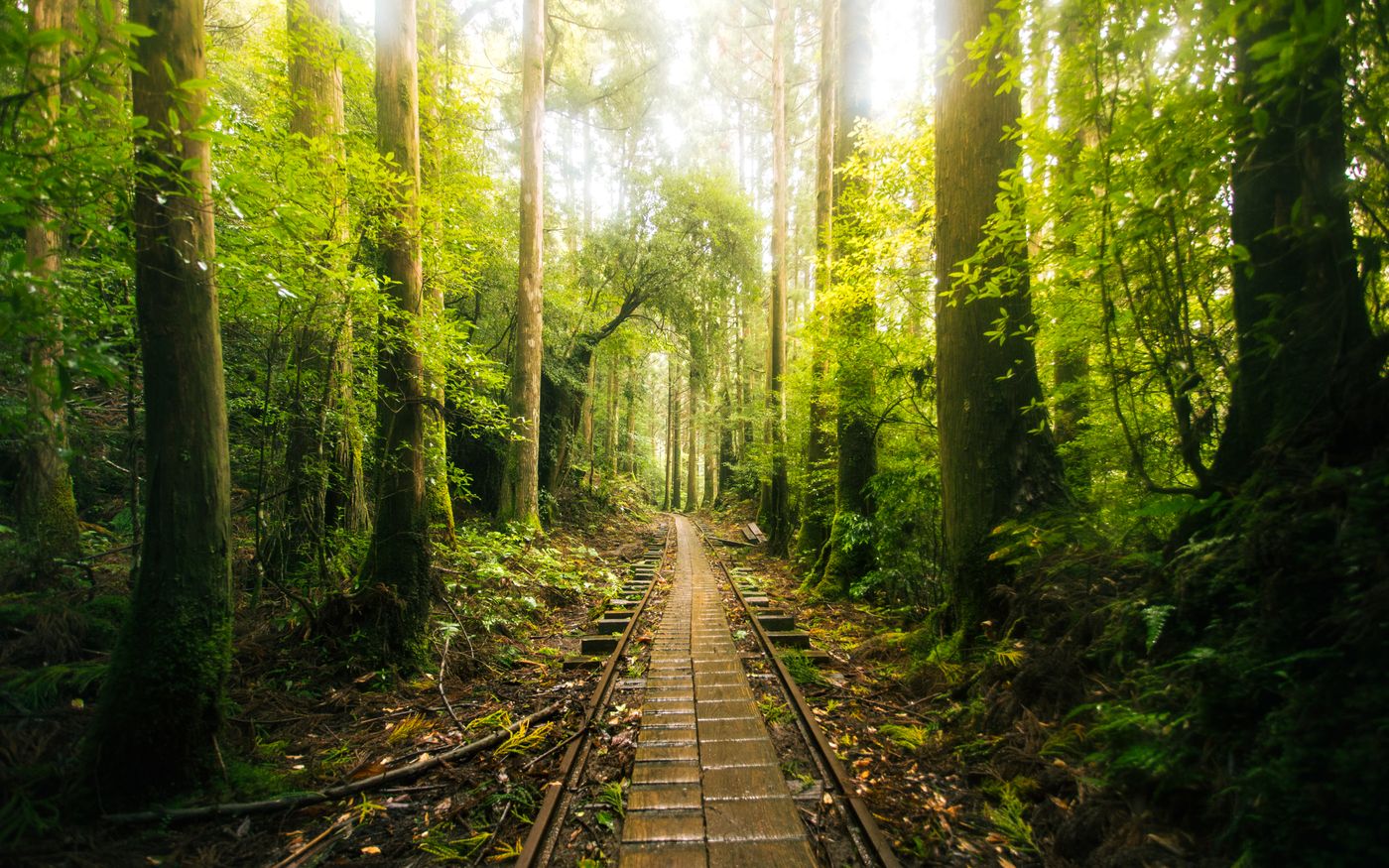
The hinoki cypress is the highest phytoncide-producing conifer in Japan — the specific combination of alpha-pinene, beta-pinene, and d-limonene in hinoki forest air creates the most measured NK cell response of any forest studied. Walking through a hinoki forest of the age and density of Akasawa — the trees several centuries old, their trunks reaching 30–40 meters — produces the smell of forest air at its most intensely aromatic: sweet, resinous, clean.
Access: From Nagoya by JR Chūō Main Line to Agematsu Station, then bus to Akasawa. Approximately 3 hours total.
Yakushima: The Forest at the Edge of the World
The ancient cedar forest of Yakushima (covered in the dedicated article) is not a formal shinrin-yoku site but is arguably Japan's most powerful forest environment. The combination of the extreme age of the trees, the density of the moss covering every surface, the constant moisture of the forest atmosphere, and the complete enclosure within the forest canopy creates conditions where the distinction between "bathing" in the forest and being overwhelmed by it becomes meaningless.
The phytoncide concentration in Yakushima's cedar forest is among the highest measured in any forest in Japan.
Aokigahara (青木ヶ原 / Sea of Trees): The Complex Case
Aokigahara — the dense forest at the northwestern base of Mount Fuji — requires honest treatment. The forest has a specific geological character (it grows on ancient lava flows, creating a floor of disrupted, cave-pocked volcanic rock that gives the forest an unusual and disorienting quality) and an internationally known association with suicide that cannot be separated from any honest description of the place.
The forest is also genuinely extraordinary in its natural character — the density of the vegetation, the absolute silence (the lava floor absorbs sound), the atmospheric quality of light filtered through the dense evergreen canopy. Japanese forest bathing practitioners do practice here, and the forest's natural properties are real. The appropriate way to visit Aokigahara is with awareness of its full character — the geological history, the natural qualities, and the human tragedy — rather than ignoring any of these dimensions.
Shirakami Sanchi (白神山地): The Untouched Beech Forest
The Shirakami Sanchi — a UNESCO World Heritage Site spanning the border of Aomori and Akita prefectures — contains the largest remaining virgin beech forest (ブナ原生林) in East Asia. Unlike the conifer forests that produce the highest phytoncide concentrations, the Shirakami beech forest offers a different sensory quality: the pale grey trunks of the beeches, the specific green-gold light through the beech canopy in summer, and the sound of wind through broad beech leaves — a sound categorically different from conifer forest wind — create a forest atmosphere of unusual gentleness.
Access: From Aomori or Akita City by car — public transport access is limited. The Anmon Falls trail (暗門の滝) provides the most accessible introduction to the forest.
Nikko's Cedar Avenue (日光杉並木): Urban Forest Bathing
The Nikko Cedar Avenue (日光杉並木) — 37 km of Japanese cedar trees planted in the early 17th century as an offering to Tōshō-gū shrine by a lord who could not afford more elaborate gifts — is one of Japan's most unusual forest environments: a forest that is a road, a road that is a forest. The cedars (approximately 12,000 surviving trees of the original 40,000) reach 30–50 meters in height, their canopy meeting above the old highway to create a tunnel of ancient forest through which Edo-period travelers once walked.
Walking the cedar avenue as a shinrin-yoku experience — slowly, attending to the scale of the trees, the quality of the filtered light, the specific smell of ancient cedar — is one of the most accessible and most distinctive forest bathing opportunities near Tokyo.
The Guided Experience
Certified Forest Therapy Guides (森林セラピーガイド) are trained by the Forest Therapy Society of Japan in the specific facilitation techniques of the practice — sensory attention exercises, seated meditation in the forest, the physiological effects of different tree species, and the integration of rest periods into the forest walk.
Several Forest Therapy Bases offer guided programs in English or with English materials: Akasawa, several Nagano Prefecture sites, and the Yakushima-adjacent programs.
Recommended Base Hotels
Nezame Hotel (Mid-range / from ¥15,000 per person): In Agematsu town near the Akasawa Natural Forest — the logical base for a multi-day shinrin-yoku program.
- Yakushima Green Hotel (Mid-range / from ¥12,000): Yakushima base for ancient cedar forest access.
- Nikko Kanaya Hotel (Luxury / from ¥25,000): Historic hotel at the base of the Nikko cedar forest.
🏨 Planning where to stay?
Every area guide on this site pairs with honest, station-by-station hotel picks. Start here: Hotel Guides by Station →