This article may contain affiliate links. If you book through them, we may earn a small commission at no extra cost to you.
Tokyo Local Culture Guide · Shotengai
Tokyo’s Shotengai: The Local Shopping Streets
That Show You the Real City
Five Streets a Tokyo Native Actually Recommends — and Why They Beat Any Department Store
🥩 Street food from ¥50
🐱 Yanaka — Tokyo’s cat street
🍢 Yakitori & standing bars
🏮 Living Showa-era atmosphere
On this page
Why Shotengai Beat Every Department Store
Most visitors to Tokyo spend their shopping time in Shibuya, Shinjuku, or Ginza. Those are fine choices. But as someone born and raised in this city, the places I’d actually take a visitor — the places where Tokyo’s character lives — are the shotengai.
A shotengai is a Japanese shopping street: a row of small, independently owned shops where the butcher, the fishmonger, the tofu maker, the sweet shop, and the hardware store operate side by side, often in the same buildings they’ve occupied for decades. The shop owner knows the regular customers by name. The prices are honest. The produce arrived this morning. Nothing about it has been curated for tourists — which is precisely why it has what tourist-facing shopping cannot: the texture of actual life.
In recent years, foreign visitors have discovered shotengai with growing enthusiasm. The reason is simple: a shotengai is the one place in Tokyo where you cannot mistake what you’re seeing for something generic. Every street has its own personality, its own smells, its own rhythm. That specificity is what travel is supposed to offer — and what shopping malls, by design, cannot.
A Brief History
The shotengai emerged from Edo-period monzenmachi (temple gate towns) and shukubamachi (post towns) — commercial strips that grew organically along pilgrimage routes and travel roads. Through Meiji, Taisho, and Showa eras, they became the center of everyday Japanese commercial life. The postwar economic boom concentrated shopping into supermarkets and eventually malls; many shotengai contracted. But they didn’t disappear. The ones that survived did so because their communities held. And those survivors are now among Tokyo’s most compelling places to spend time.
Five Shotengai Worth Your Time
🐱 1. Yanaka Ginza (Taito Ward)
MOST ICONIC
📍 5 min walk from Nippori Station (JR Yamanote Line / Keisei Line)
Any list of Tokyo’s shopping streets begins here. Yanaka Ginza survived the WWII firebombings, which means it retains prewar wooden buildings that were lost almost everywhere else in central Tokyo. The result is a 170-meter street that feels genuinely different from the rest of the city — not because it has been restored or themed, but because it was simply never destroyed.
Over 60 shops pack into the narrow street: butcher, fish shop, tofu stall, croquette vendors, cat-goods stores (the neighborhood is famous for its resident cats), old sweet shops where the owner makes things by hand in full view. The Yuyake Dandan steps at the street’s entrance face west — at dusk, the view of the setting sun over the rooftops is one of Tokyo’s simplest and most genuinely moving urban moments.
What to eat: Menchi katsu (ground meat cutlets, fried to order) · Dorayaki from old sweet shops · Korokke (croquettes) — compare between shops
✦ Local tip: The “living” quality here — shops open, owners present, local customers buying dinner ingredients — is what makes Yanaka irreplaceable. Come between 3pm and 6pm for the fullest atmosphere. Talk to the shop owners; many will respond warmly even without shared language.
🍢 2. Togoshi Ginza (Shinagawa Ward)
LONGEST IN TOKYO
📍 Togoshi-Ginza Station (Tokyu Ikegami Line, immediate) / Togoshi Station (Toei Asakusa Line, 3 min walk)
There are over 300 shopping streets in Japan with “Ginza” in their name. Togoshi Ginza is the original — the street that coined the branding after receiving bricks from the real Ginza following the 1923 earthquake. At 1.3km, it’s one of the longest shotengai in Tokyo, with approximately 400 shops across its full length.
What distinguishes Togoshi is its near-total orientation toward local life. There is almost nothing here aimed at visitors. The customers are the neighborhood’s residents — doing their daily shopping, chatting with shop owners they’ve known for years, picking up yakitori on the way home. Yakitori is the street’s signature food: multiple vendors grill chicken skewers over charcoal throughout the day, and by late afternoon the smoke fills the whole street. Prices run ¥100–¥150 per skewer.
What to eat: Charcoal-grilled yakitori (the street’s signature) · Simmered dishes from prepared food shops · Seasonal wagashi from traditional sweet makers
✦ Local tip: The lack of tourist infrastructure is a feature. When local people don’t treat you as a visitor — when they simply carry on around you — that’s when you know you’ve found the real city.
🏮 3. Jujo Ginza (Kita Ward)
MOST AUTHENTIC
📍 2 min walk from Jujo Station (JR Saikyo Line)
If Yanaka Ginza is the most atmospheric and Togoshi is the longest, Jujo Ginza is the most unmediated. There is nothing here for tourists. The 250-meter covered arcade feels unchanged from the 1960s: a butcher with handwritten price tags, a greengrocer arranging vegetables by hand, a pickle shop where the owner made the pickles herself.
By day it’s elderly residents and local mothers; by evening it fills with workers stopping for motsu-yaki (grilled offal) at the standing bars in the alleys off the main arcade. Sitting shoulder to shoulder with strangers at a counter, eating charcoal-grilled offal and drinking beer at dusk — this is the version of Tokyo that most visitors never reach, and the one that stays with you longest.
What to eat/drink: Motsu-yaki (grilled offal, evening only) · Freshly fried korokke and furai · Prepared dishes from neighborhood souzai shops
✦ Best for experienced travelers who want depth over comfort. The most rewarding shotengai on this list for those willing to step fully out of tourist circuits.
🐟 4. Sunamachi Ginza (Koto Ward)
BEST VALUE
📍 10 min walk from Minami-Sunamachi Station (Tokyo Metro Tozai Line)
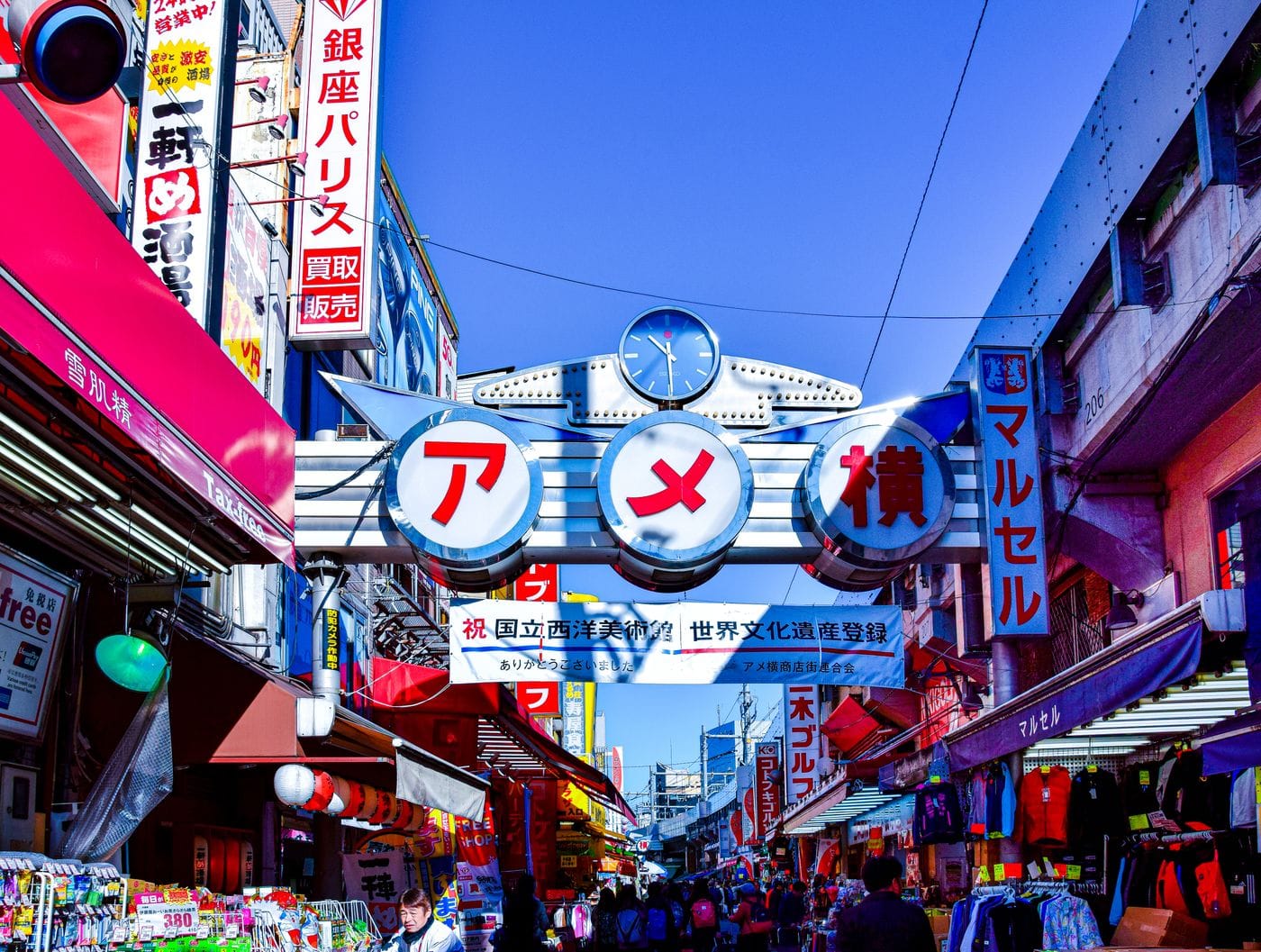
For sheer value-to-quality ratio, no shotengai in Tokyo matches Sunamachi Ginza. The 770-meter street is dominated by food sellers — fish, meat, tofu, vegetables, prepared dishes — and the prices are extraordinary. Croquettes at ¥50–100. Freshly fried fish cutlets. Tofu made the same morning from a shop that has been there for generations. The street’s local reputation is “the kitchen of the shitamachi” — and it earns that name daily.
The fish counter is worth noting: whole fish on ice, brought in that morning, with the fishmonger cutting to order. It’s a standard of freshness that the city’s supermarkets cannot match, at prices that make the comparison almost embarrassing.
What to eat: Fried dishes (aji furai, kaki furai, korokke) at ¥50–100 each · Morning tofu from the tofu shop · Simmered dishes and oden from the prepared food counters
✦ Access requires a slightly longer walk from the metro, but this is, in my view, exactly the kind of place that rewards the effort. Few visitors find it. The ones who do come back.
☔ 5. Musashi-Koyama Shopping Arcade (Shinagawa Ward)
BEST IN RAIN
📍 Immediate from Musashi-Koyama Station (Tokyu Meguro Line)
Tokyo’s longest fully covered shopping arcade — 800 meters — makes Musashi-Koyama the natural choice on a rainy day. Every category of neighborhood shop is represented under one continuous roof: food, clothing, household goods, cafés, beauty, books, ¥100 shops. It functions less like a shopping street and more like an entire neighborhood that happens to have a roof.
In recent years, craft beer bars and independent cafés have opened alongside the older establishments, creating a generational mix that feels natural rather than curated. The standing-drink culture here — tachinom bars where locals stop for a glass in the middle of the afternoon — is one of the most convivial and accessible social experiences available in Tokyo for visitors who don’t speak Japanese. A raised glass communicates everything necessary.
What to eat/drink: Fried foods from the butcher shops (the street’s soul food) · Craft beer from independent bars · Handmade wagashi from long-standing sweet shops
✦ The tachinom (standing bar) culture here is particularly accessible to non-Japanese speakers. Order a drink, stand at the counter, and the rest follows naturally.
Practical Guide: Getting the Most from a Shotengai Visit
🕐 Best Time to Visit
Most shops open 10am–6pm. The richest atmosphere is 4pm–6pm — workers stopping in, dinner preparations beginning, full activity. Avoid Mondays: many independent shops take Monday as their rest day.
📸 Photography
Always ask before photographing people or the interiors of small shops. The request itself — even in mime — is usually warmly received. Many owners are happy to pose; some will decline. Both responses are honest.
💬 Language
English is rarely spoken. Pointing works. A calculator for prices works. A smile and a bow work better than either. The communication that happens without shared language in a shotengai is often the most memorable part of the visit.
💴 Payment
Many small shotengai shops are cash-only. Carry small bills (¥1,000 notes) and coins. IC cards (Suica/Pasmo) may work at some shops but not all.
Recommended Hotels by Shotengai Area
For Yanaka Ginza & Jujo
Ueno / Nippori area. Combines well with Nippori’s Narita Skyliner access, Ueno museums, and the full Yanesen district walk.
Dormy Inn Ueno Okachimachi (Mid-Range / from approx. ¥14,000 ~$93 USD) — Natural hot spring, ideal after a full walking day.
Lamplight Books Hotel Tokyo (Mid-Range / from approx. ¥15,000 ~$100 USD) — Culturally fitted to the Yanesen area’s literary atmosphere.
For Togoshi Ginza & Musashi-Koyama
Shinagawa / Gotanda area. Excellent Haneda access via Keikyu Line; good base for south Tokyo exploration.
Tosei Hotel Cocone Gotanda (Mid-Range / from approx. ¥12,000 ~$80 USD) — 3 min from Gotanda Station; well-positioned for both shotengai.
Shinagawa Prince Hotel (Mid-Range / from approx. ¥15,000 ~$100 USD) — Direct Keikyu Line access to Haneda.
For Sunamachi Ginza
Kinshicho / Tatsumi area. Eastern Tokyo base combining well with Asakusa, Skytree, and the shitamachi east.
Toyoko Inn Kinshicho Ekimae (Economy / from approx. ¥8,000 ~$53 USD) — 2 min from Kinshicho Station; strong value for east Tokyo exploration.
All prices approximate. Check current rates on booking sites — seasonal variation is significant.
Access Summary
| Shopping Street | Nearest Station | Line | Walk |
|---|---|---|---|
| Yanaka Ginza | Nippori | JR Yamanote / Keisei | 5 min |
| Togoshi Ginza | Togoshi-Ginza | Tokyu Ikegami Line | Immediate |
| Jujo Ginza | Jujo | JR Saikyo Line | 2 min |
| Sunamachi Ginza | Minami-Sunamachi | Tokyo Metro Tozai Line | 10 min |
| Musashi-Koyama | Musashi-Koyama | Tokyu Meguro Line | Immediate |
Why a Shotengai Day Is Tokyo’s Best Day
Tokyo’s shopping streets are where the city actually lives. Walk one on a weekday afternoon. Buy something fried. Stand next to a local at a counter. That evening, you’ll be certain of something most visitors miss: you’ve been to the real Tokyo.
✔ Food and street culture enthusiasts
✔ Repeat Tokyo visitors wanting depth
✔ Photographers seeking authentic scenes
✔ Travelers who dislike tourist circuits
✔ Anyone who wants to eat well for ¥500
🏨 Planning where to stay?
Every area guide on this site pairs with honest, station-by-station hotel picks. Start here: Tokyo Hotel Guides →