This article may contain affiliate links. If you book through them, we may earn a small commission at no extra cost to you.
On this page
Introduction: Japan's Most Beautiful Moving Scenery
Cherry blossom season in Japan produces a specific travel opportunity available nowhere else on earth: the sakura train journey — riding through a landscape transformed by simultaneous bloom, the train windows framing compositions that change every thirty seconds. Japan's rail network, built through valleys and along river corridors where cherry trees have been planted for generations, produces sakura viewing experiences that the fixed viewpoints of parks and temples cannot replicate.
The following routes are selected for the combination of sakura density, landscape quality, and the specific visual opportunity of viewing blossom from a moving train.
The Best Sakura Train Routes
Randen "Sakura Tunnel" (嵐電 桜のトンネル), Kyoto
The Randen (Keifuku Electric Railroad) Kitano Line passes through a roughly 200-meter stretch between Narutaki and Utano stations where cherry trees line both sides of the track and meet overhead — Kyoto's celebrated Sakura Tunnel. At peak bloom — typically late March to mid-April — the small trams slow through the section so passengers can take in the canopy of blossom.
Night sakura runs: In some years Randen lights the cherry section after dark and runs slow evening services through it — the enclosed canopy of illuminated blossom produces some of the most celebrated sakura train photography in Kyoto. Check the Randen website for the current season's plans.
- Access: The Kitano Line runs between Kitano-Hakubaicho (near Kinkaku-ji) and Katabiranotsuji; from central Kyoto, board the Randen main line at Shijo-Omiya.
Tsugaru Railway (津軽鉄道), Aomori: Northern Sakura
The Tsugaru Railway — a narrow-gauge rural line in Aomori Prefecture connecting Goshogawara and Tsugaru-Nakazato — is famous in Japan for two seasonal trains: the winter Stove Train (ストーブ列車) (coal stoves in each car warming passengers through the Aomori winter) and the spring Sakura Train, when the line's embankments and the surrounding landscape bloom approximately 2 weeks after Tokyo.
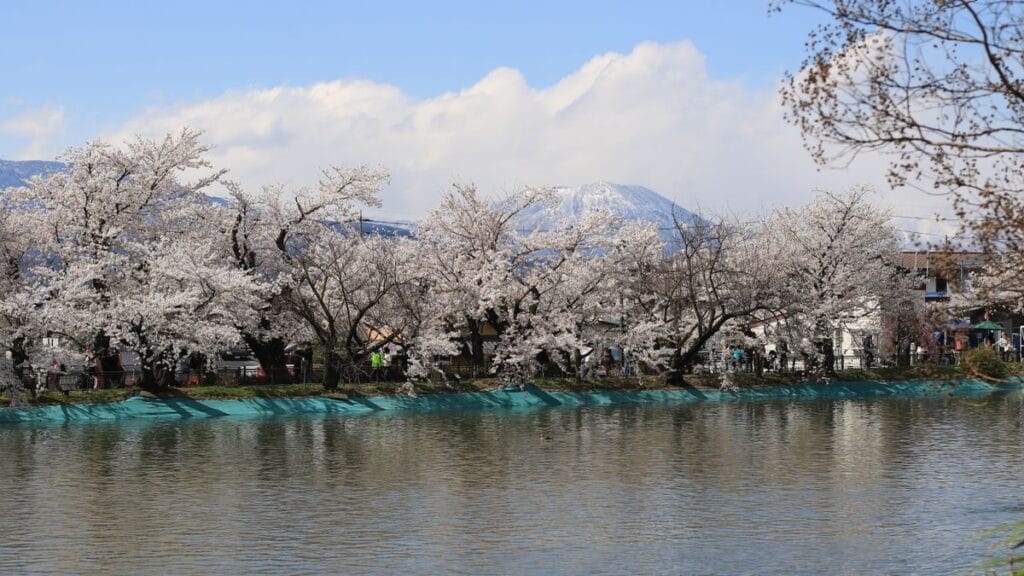
The northern latitude means the Tsugaru sakura bloom occurs in late April to early May — when cherry blossom is finished in most of Japan, the rural north is just beginning. The combination of late snow still visible on the distant mountains and fresh cherry bloom at lower elevation creates a specific seasonal image unavailable in the south.
Jōetsu Line (上越線) in the Tone Valley, Gunma
The Jūetsu Line between Takasaki and Minakami follows the Tone River through Gunma Prefecture's mountain approaches — a series of river valley bends where the embankments are heavily planted with cherry trees. The spring journey produces a rapid sequence of composed river-valley-blossom views that demonstrates exactly why Japan's train-and-sakura combination is considered worthy of attention.
Onsen bonus: The Jōetsu Line continues to Minakami — one of the Kanto's finest onsen areas — making this route naturally combinable with a sakura view and hot spring trip.
Hitachinaka Seaside Railway Minato Line (ひたちなか海浜鉄道湊線), Ibaraki
The small Minato Line connecting Katsuta with Ajigaura passes through the suburban landscape of coastal Ibaraki with minimal sakura on the route itself — but the destination (Hitachi Seaside Park / 国営ひたち海浜公園) contains hundreds of cherry trees alongside its famous nemophila (ネモフィラ) blue wildflower fields that peak in late April. The train journey to the park, through an ordinary Japanese suburb that transforms at the platform into a seaside park of extraordinary flower density, provides the surprise of arrival.
Sagano Scenic Railway (嵯峨野観光鉄道), Kyoto: The Arashiyama Canyon
The Sagano Scenic Railway (トロッコ列車) — a tourist train running between Saga and Kameoka through the Hozugawa Gorge (保津峡) — operates through a narrow river gorge where cherry trees planted on the gorge walls and beside the river create a late-season blossom (slightly later than the city due to the valley microclimate) framed by the distinctive gorge topography.
The open-sided carriages of the tourist train (one car has no walls) maximize the wind and blossom scent experience — a design decision that makes perfect sense in cherry blossom season and requires extremely warm clothing in other seasons.
Combination: The Sagano train runs one-way; the return can be made by boat down the Hozu River (保津川下り) — a river rafting experience that follows the same gorge from a different angle.
Tarumi Railway (樽見鉄道), Gifu: The 1,500-Year-Old Cherry Tree
The Tarumi Railway — a one-car rural line running north from Ogaki into the Neo Valley — is one of Japan's great sakura branch lines: long stretches of track are planted with cherry trees, and the terminus at Tarumi is the gateway to the Usuzumi-zakura (淡墨桜), a monumental tree said to be more than 1,500 years old whose blossoms fade from pale pink to ash-white as they fall. Extra trains run during the early-April bloom. (The SL Hitoyoshi steam train in Kumamoto, long a fixture of lists like this one, made its final run in March 2024.)
Planning Sakura Train Journeys
Timing variability: Cherry blossom peak moves northward from late March (Kyushu, Tokyo) through mid-May (northern Tohoku, Hokkaido) — planning a northward journey in April can sustain sakura season for 2–3 weeks.
The Japan Meteorological Corporation (日本気象株式会社) cherry blossom forecast is published annually and provides prefecture-by-prefecture predicted peak dates — essential for precise timing.
Train photography: The most effective sakura train photographs are taken from outside the train (at stations or level crossings) rather than from inside — the moving train with blossom-lined tracks before it. Plan to be at specific stations or crossings at the time the train passes rather than always being on the train.
Recommended Base Hotels
- Arashiyama area ryokan: For Sagano Railway access.
- Minakami Onsen (水上温泉): For the Jūetsu Line sakura + onsen combination.
- Goshogawara area guesthouses: For the Tsugaru Railway northern sakura experience.
🏨 Planning where to stay?
Every area guide on this site pairs with honest, station-by-station hotel picks. Start here: Hotel Guides by Station →