This article may contain affiliate links. If you book through them, we may earn a small commission at no extra cost to you.
Kyoto Guide · Hidden Temples
Kyoto’s Lesser-Known Temples:
Kokedera, Daitoku-ji & the Quiet Side
Kyoto Has 1,600 Temples. The Average Visitor Sees Five. This Fixes That.
🌿 Kokedera (苔寺) — 120 species of moss · reservation required
⛩️ Daitoku-ji — 22 sub-temples most visitors skip
🍁 Enko-ji — finest autumn garden no one knows
🏡 Koto-in — Japan's most beautiful temple approach (long-term closed — see note)
On this page
🌿 Kokedera (苔寺 / Saihō-ji): The Moss Garden
Saihō-ji (西芳寺) is in a category entirely its own. The garden — a UNESCO World Heritage Site covering ~1.5 hectares — contains over 120 species of moss, creating a landscape of extraordinary texture and depth. The moss shifts from emerald green to deep jade to yellow-gold depending on light and season.
📮 The Reservation Requirement — Why It Matters
Kokedera cannot simply be visited. You must apply in advance — traditionally by return postcard, and now also via the online form on the temple's website. Reservation confirmed by return confirms your contribution (~¥4,000) which includes a sutra-copying (写経 / shakyō) session that precedes the garden visit. This deliberate barrier filters visitors — you will typically be with ~30–50 people rather than the thousands at Kinkaku-ji. This is not bureaucracy; it is preservation.
The garden was originally designed in the 8th century and reached its current form under Zen master Musō Soseki in 1339 — the same designer responsible for Tenryū-ji’s garden. The central pond (shaped like the character for “heart” 心) is surrounded by the moss forest. Walking through deep moss — soft underfoot, luminously green, the texture changing constantly — is unlike any other garden visit in Japan. Several visitors describe a disorienting quality: the moss removes boundaries between elements, creating a garden with visual immensity disproportionate to its physical size.
✦ Best season: June (rainy season — moss most vivid) and November (autumn leaves on green moss). Website: www.saihoji-kokedera.com
⛩️ Daitoku-ji (大徳寺): The Complex of 22 Sub-Temples
Daitoku-ji is not a single temple but a vast complex of 22 sub-temples (塔頭 / tatchū), several containing Kyoto’s finest dry gardens, most important tea culture history, and best-preserved medieval painting collections — almost entirely unvisited. Founded in 1319 and rebuilt under powerful Zen-affiliated warlords in the 16th century, it became the center of Zen aesthetics and samurai culture intersecting to produce some of Japan’s most refined artistic achievements.
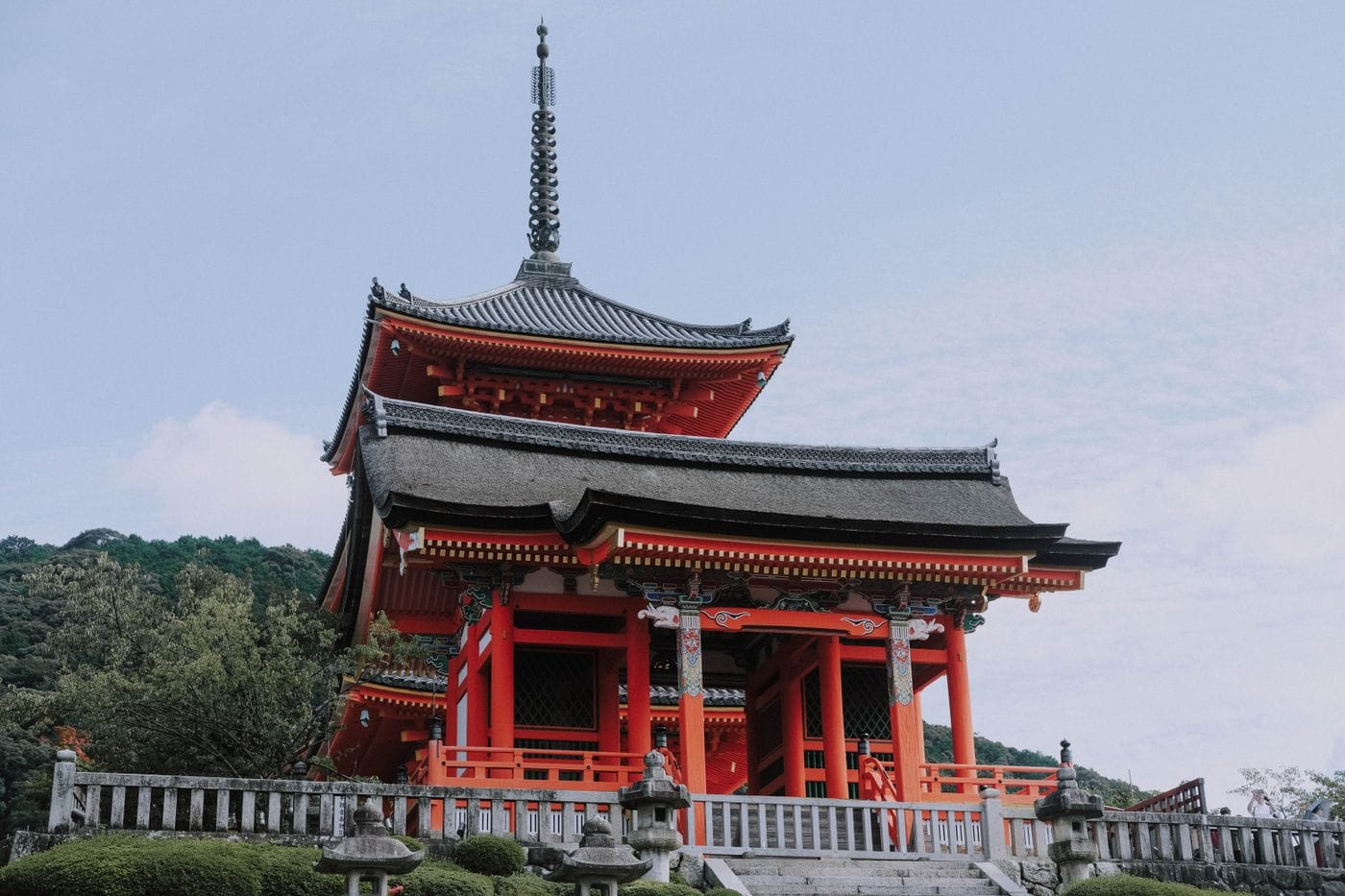
Daisen-in (大仙院) · ~¥500
One of Kyoto’s finest dry gardens — a narrow L-shaped space using rocks, white gravel, and moss to represent a mountain landscape, river valley, and ocean in a sequence that reads almost as a painted scroll translated into stone and sand. The guiding monk’s explanation of symbolic content is worth attending.
Kōtō-in (高桐院)
Perhaps the most beautiful temple approach in Japan: a long, perfectly straight stone path lined on both sides by dense maple trees, leading to a gate of a sub-temple renowned for its tea house and moss garden. In autumn, maple leaves covering the stone path create one of Kyoto’s finest foliage images. Note: Kōtō-in has been closed to visitors long-term (since 2020; no reopening date as of July 2026) — the approach can be glimpsed from outside, and the neighbouring sub-temples Kōrin-in and Ōbai-in open specially in autumn.
Ryōgen-in (龍源院)
Contains five small gardens including what is claimed to be Japan’s smallest dry garden (2.4 square meters). The compressed intensity of a complete garden composition in a space smaller than a parking space is a reminder of what Japanese garden design is fundamentally about: not size, but composition and meaning.
🍁 Enko-ji (圓光寺): Autumn Without Crowds
Enko-ji receives approximately 1% of Tofuku-ji’s visitors during autumn. The central garden — a pond surrounded by maples with stone arrangements and moss floor — produces, at peak autumn, one of the finest images available in Kyoto. The upper section provides an elevated view across the Kyoto basin: foliage in the foreground, the city basin in the distance, a uniquely expansive autumn view. Open from 9:00 AM; arrive at opening for the best light and emptiest grounds.
Hotels
Hotel Granvia Kyoto (Mid-Range / from approx. ¥20,000 ~$133 USD) — at Kyoto Station, easy bus and subway starts for both Kokedera and Daitoku-ji. Nishiyama Ryokan (Mid-Range / from approx. ¥20,000/person ~$133 USD) — friendly central-Kyoto ryokan. Prices approximate.
Who Should Visit These Temples
✔ Repeat Kyoto visitors who’ve seen the famous sites
✔ Garden & Zen aesthetics enthusiasts
✔ Those willing to plan ahead (Kokedera reservation)
✔ November visitors wanting autumn foliage without queues
🏨 Planning where to stay?
Every area guide on this site pairs with honest, station-by-station hotel picks. Start here: Kyoto Hotel Guides →